A site crew finishes grading a new parking lot and lays down a fresh layer of aggregate, ready for paving the next morning. Skipping the roller to save an hour, the foreman figures the base looks solid enough and calls it a day. Six months later, ruts and cracks spider across the finished asphalt, water pools where the ground settled, and the client demands a costly repair on work that should have lasted years. That failure traces back to one missing step: proper compaction. Understanding what a road roller does, and why it matters, separates surfaces that hold up from ones that crumble.
Compaction sits at the heart of nearly every paving, grading, and site-prep job, and a road roller is the machine built to deliver it. Pressing loose material into a dense, stable mass, the roller creates the firm foundation that roads, lots, driveways, and building pads depend on. This guide walks through how the machine works, the main jobs it handles, the types available and where each fits, why compaction shapes durability and safety, how to match a roller to your project, and the return it delivers for a working contractor. Here’s what you need to know before the next lift goes down.
How the Machine Actually Works
Weight and force are the whole story behind a road roller. At its simplest, the machine rolls one or more heavy steel drums or rubber tires over loose material, pressing air and gaps out of the mix until the particles lock tightly together. That dense, compacted layer resists shifting, settling, and water intrusion far better than the loose material ever could.
Static weight alone handles some jobs, but most modern rollers add vibration to multiply their force. An eccentric weight inside the drum spins to create rapid vibrations, driving the compaction energy deeper into the material than the machine’s raw weight could reach on its own. Vibratory rollers pack thicker lifts and denser results, which is exactly why they dominate paving and heavy site work.
Control over that force is what turns a heavy machine into a precision tool. Operators adjust amplitude and frequency to match the material and lift thickness, using gentle static rolling on thin finish passes and stronger vibration on deep base courses. Matching the energy to the job keeps the surface clean and the compaction thorough, so the machine works with the material rather than pounding it into a bruised, uneven finish.
The Main Jobs a Road Roller Handles
Asphalt compaction is where most people picture a road roller, and for good reason. After a paver lays a hot mat, the roller follows behind to press the asphalt into a smooth, dense surface that seals out water and carries traffic for years. Timing and technique matter here, since the mat has to be compacted while it’s still hot enough to move under the drum.
Soil and subgrade work forms the second major role, and it happens long before any asphalt appears. Before a road, foundation, or lot goes in, the underlying soil has to be compacted to a stable base, or everything built on top of it settles and fails. Running a roller across the subgrade locks the ground in place, giving the structure above something firm to rest on.
Aggregate and gravel compaction ties the two together. Between the raw soil and the finished surface sits a layer of crushed stone or gravel that also needs packing, and the roller handles that lift just as it handles the others. Driveways, walkways, patio bases, and road sub-bases all rely on well-compacted aggregate, and a roller delivers the dense, level foundation each of those surfaces demands to last.
Types of Road Rollers and Where Each Fits
Different jobs call for different rollers, so knowing the main types keeps you from forcing the wrong machine onto the work. Each design solves a particular compaction problem, and matching the type to the material saves both time and rework.
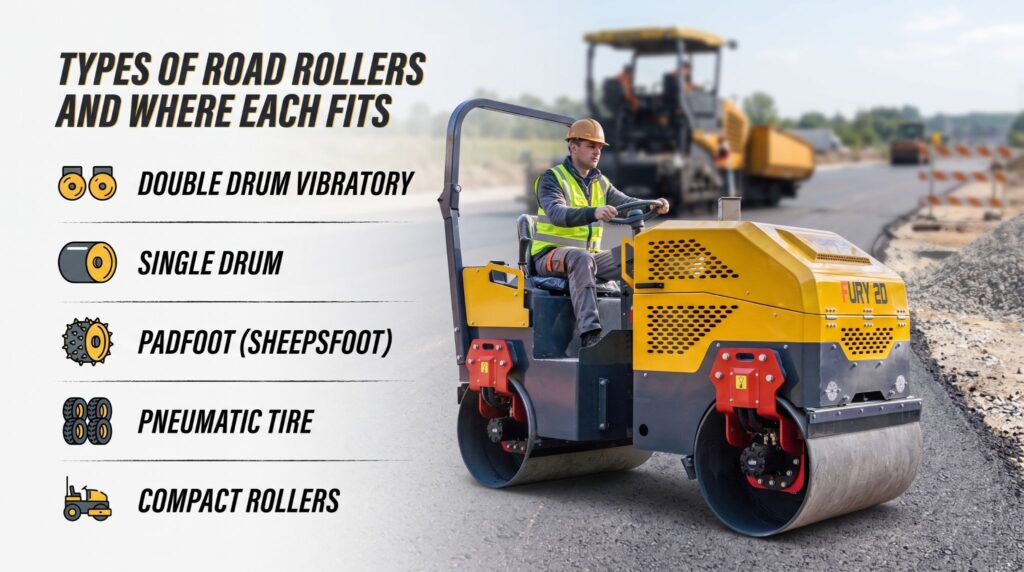
Here’s a look at the rollers you’ll encounter most:
- Double drum vibratory rollers: Carrying a steel drum front and rear, these pack asphalt and granular material to a dense, smooth finish. They’re the go-to for paving roads, lots, and driveways where a clean surface matters most.
- Single drum rollers: Pairing one steel drum with rubber drive tires, these excel at compacting soil, subgrade, and thick aggregate lifts on site-prep and earthwork jobs.
- Padfoot (sheepsfoot) rollers: Fitted with raised pads on the drum, these knead deep into cohesive soils like clay, driving compaction below the surface where a smooth drum can’t reach.
- Pneumatic tire rollers: Riding on rows of rubber tires, these seal and finish asphalt with a kneading action that smooths the surface and closes small voids.
- Compact rollers: Sized for tight residential sites, these clear narrow gates and driveways a full-size machine can’t reach while still packing base and asphalt cleanly.
Choosing among them comes down to the material and the space. Smooth drums finish asphalt and granular fill, padfoot drums handle deep clay compaction, and pneumatic tires seal a paved surface. Sizing the machine to the site rounds out the pick, since a full-size roller wastes its capability on a cramped driveway while a compact unit strains against a highway job.
Why Proper Compaction Shapes Durability and Safety
Longevity starts with density, and that connection is the whole reason compaction matters. Loose, poorly packed material shifts and settles under traffic and weather, which cracks pavement, creates ruts, and shortens a surface’s life dramatically. Well-compacted layers hold their shape for years, so the roller directly determines how long the finished work lasts.
Water is the enemy that poor compaction invites in. When gaps remain in the base or surface, water seeps through, pools, and freezes, and each cycle widens the damage until the surface fails. Dense compaction closes those voids and sheds water instead of absorbing it, protecting the structure from the freeze-thaw cracking that destroys underprepared roads and lots.
Safety rides on that same foundation more than most people realize. A properly compacted road or lot carries traffic evenly, drains water off the surface, and resists the potholes and soft spots that cause accidents and equipment damage. Skimping on compaction to save time creates hazards and callbacks that cost far more than the rolling ever would, so the machine protects both the client’s investment and the people who use the finished surface. A common mistake worth naming: rushing a base course or skipping passes to beat a deadline, which trades a few saved minutes for a surface that fails within a season.
Matching the Roller to Your Project
Project type points you toward the right machine faster than any spec sheet, so start by picturing the work. Highway and large-lot paving calls for a full-size double drum vibratory roller that covers ground quickly, while a driveway or backyard patio suits a compact machine that fits tight access and treads gently near finished surfaces. Sizing the roller to the site keeps you from bringing too much machine or too little.
Material drives the choice just as strongly. Asphalt and granular fill reward a smooth drum, deep clay soils demand a padfoot drum that kneads below the surface, and a finish pass on paving benefits from pneumatic tires that seal the mat. Reading the material before you rent or buy keeps the machine matched to what you’re actually compacting rather than what you compacted last time.
Site conditions round out the decision, and they’re easy to overlook until they cause trouble. Tight residential lots, soft ground, and slopes each shift which machine handles the job safely, so account for access, terrain, and surrounding surfaces before committing a roller to the work. Confirming the machine’s weight, drum width, and vibration settings suit both the material and the lift thickness keeps every pass productive and the finish clean.
Value and ROI for Contractors
Cost is the question every contractor weighs first, and a road roller answers it through the failures it prevents. Proper compaction is what keeps a finished surface from cracking, rutting, and settling, which means the machine directly protects you from the callbacks and warranty repairs that eat into a job’s profit. One prevented failure often covers a meaningful share of what the roller costs to run.
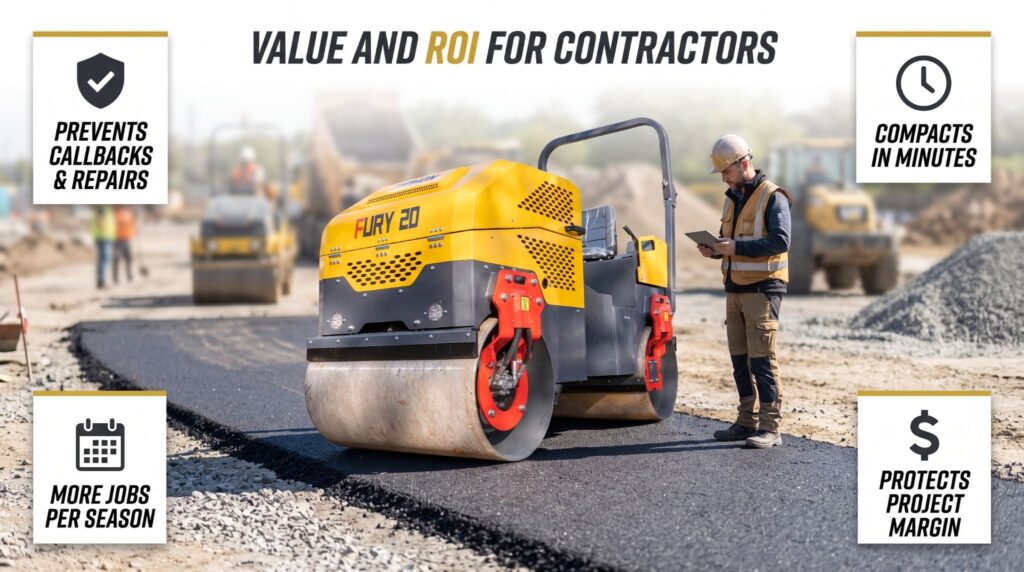
Productivity stacks on top of that protection. A roller compacts in minutes what would take a crew with hand tampers hours to accomplish, and it does the work more thoroughly than hand equipment ever could. Faster compaction means faster job turnaround, more jobs per season, and less labor tied up in a task the machine handles better on its own.
Whether owning beats renting comes down to how often you compact. Crews running steady paving and site work recoup a roller’s cost quickly across a busy season, while contractors who face compaction only occasionally may find renting for those stretches fits better, so weighing your real workload against the purchase price keeps the spend lean. Compact rollers put capable compaction within reach of small residential crews, while larger operations justify a full-size machine on volume alone. Whichever route you choose, following a steady maintenance routine protects the investment, and training operators on safe practices protects your crew on every site.
Conclusion
A road roller compacts loose material into the dense, stable foundation that roads, lots, driveways, and building pads depend on to last. Using weight and vibration, it presses asphalt, soil, and aggregate into a firm mass that resists settling, sheds water, and carries traffic for years, and the type of roller you choose, from double drum to padfoot to compact, should match the material and the site. Proper compaction isn’t a step worth skipping, since it directly shapes how long a surface lasts and how safely it performs, while poor compaction invites cracking, rutting, and costly repairs. Match the machine to your project by weighing the work, the material, and the site conditions together, and factor in whether owning or renting fits your real workload. Get compaction right and you protect both your client’s investment and your own reputation on every job. When you’re ready to put a dependable road roller to work, reach out to a trusted equipment specialist who can pair a reliable machine with the results your projects depend on.
Frequently Asked Questions
What is a road roller used for?
A road roller compacts loose material into a dense, stable surface, pressing asphalt, soil, gravel, and aggregate into a firm foundation for roads, parking lots, driveways, and building pads. Using weight and often vibration, it removes air and gaps so the finished surface resists settling, sheds water, and holds up under traffic for years.
Why does proper compaction matter so much?
Compaction determines how long a surface lasts and how safely it performs. Well-compacted layers resist cracking, rutting, and water intrusion, while poorly packed material settles and fails within a season, creating potholes, soft spots, and drainage problems that lead to hazards and expensive repairs down the road.
What type of road roller do I need for my project?
It depends on the material and the site. Double drum vibratory rollers finish asphalt and granular fill, single drum and padfoot rollers compact soil and subgrade, pneumatic tire rollers seal paved surfaces, and compact rollers fit tight residential jobs. Match the drum type to what you’re compacting and the machine size to your access and terrain.