
Excavation on steep hillsides requires careful control of machine position, bucket reach, and ground conditions. Extending the arm across a slope can reduce repositioning, but it may increase instability risks, particularly when digging dense material or swinging heavy loads. Soft soil, seepage, buried utilities, and spoil placed near the excavation edge can further complicate work and threaten both equipment safety and slope stability.
Digging reach and performance depend on boom and arm geometry, bucket configuration, machine orientation, soil resistance, and operator visibility. Working near the outer limit of the excavator’s range can reduce digging effectiveness and make precise bucket control more difficult, while uneven support conditions can affect stability during lifting and swinging. Working range diagrams, applicable load charts, and manufacturer instructions help determine suitable machine positions and operating limits for the terrain.
Safe hillside excavation starts with evaluating slope conditions, establishing a stable working platform, and planning the sequence so the bucket operates within a suitable range. Spoil should be staged away from excavation edges according to site requirements, and buried utilities must be located and verified before digging. Drainage control, regular slope inspections, appropriate bucket loads, and spotter assistance when visibility is restricted help maintain control as ground conditions change.
Understanding Digging Reach on Slopes
Digging reach describes the horizontal distance the bucket can extend from the machine’s reference point, usually the swing center. Manufacturers measure it on firm, level ground with the machine in a defined configuration, including a specific boom, arm, and bucket. That figure is useful for comparing machines, but it describes ideal conditions rather than a hillside.
On sloping ground, usable reach can differ from what is possible on level terrain. When the machine sits on a grade, its position and boom geometry change relative to the excavation area. Reaching downhill may let the bucket touch points lower than the level-ground diagram suggests, while reaching uphill typically shortens how far and how deep the bucket can work. A machine set on a bench above the cut also loses depth in proportion to the height of that bench.
The working range diagram in the operator’s manual shows the outer boundary the bucket tip can reach at every height and depth for a given configuration. Read it alongside the lift chart, since lifting capacity and stability drop as the arm extends. A point the bucket can touch on the diagram may still fall outside the area where the machine can safely carry a heavy load, especially on a slope where the load’s leverage works with gravity instead of against it.
Before committing to a setup, measure the horizontal distance and elevation difference from the planned machine position to the farthest and deepest points of the excavation. Compare those figures with the diagram for your actual configuration, and leave a margin. On the vineyard job, a single long-reach setup looked efficient on paper but pushed the machine into the weakest part of its envelope.
Key takeaway: Digging reach is measured on level ground, so consult the manufacturer’s working-envelope information for your configuration and measure real distances and elevations on the slope before relying on any reach figure.
Positioning the Excavator
Proper excavator positioning helps maintain stability, improve digging reach, and reduce unnecessary strain on the machine. On steep sites, choosing a safe working position is essential to prevent ground failure and loss of control.
- Working Reach: Position the machine so the bucket can reach the work area comfortably without overextending or making awkward swings.
- Slope Stability: Keep the excavator well back from unstable edges, where soil may collapse under the machine’s weight and digging forces.
- Safe Setbacks: Follow site requirements for edge distances and treat limits set by a geotechnical engineer or competent person as mandatory.
- Ground Assessment: Check soil conditions and slope stability before positioning the machine, especially near fresh cuts or loose ground.
- Controlled Operation: Avoid positions that push the machine beyond its working limits or increase the risk of tipping or ground collapse.
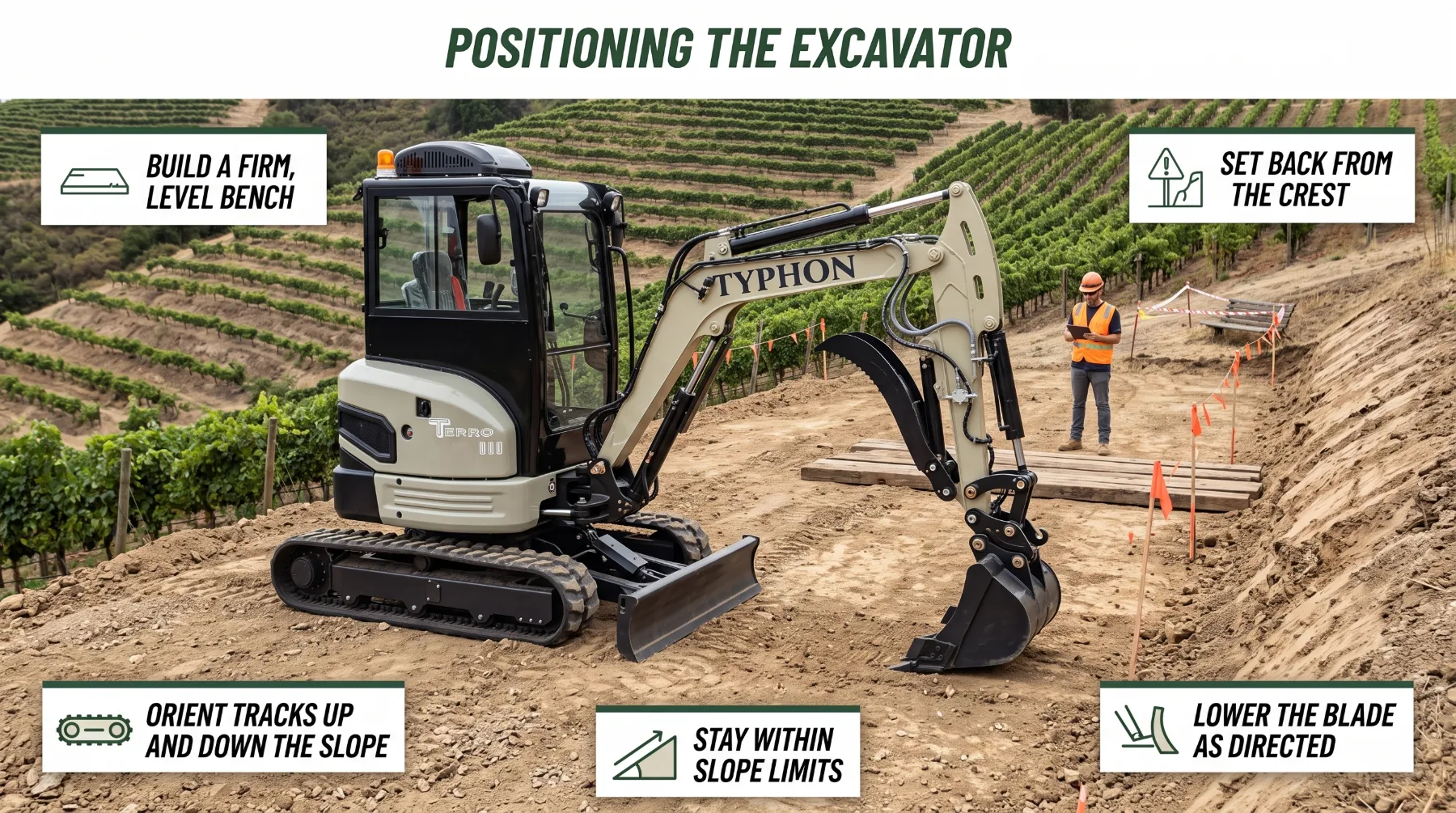
Establish a working position on ground capable of supporting the machine. On many steep sites, that means cutting a level bench wide enough for the full track length and turning room, then compacting it or laying timber mats over soft areas. Build the bench into firm native ground rather than onto loose fill. Probe the surface before moving onto it, and watch for soft spots, buried voids, and areas softened by water.
Orientation matters as much as location. Many manufacturers recommend positioning the tracks straight up and down the slope rather than across it, since a machine set across a grade is far more sensitive to sideways tipping. If the excavator has a dozer blade, the manual may direct you to lower it on the downhill side for added support during digging. Follow the manufacturer’s slope operating limits for your machine, and never exceed them to gain a few extra feet of reach.
Key takeaway: Set the excavator on a firm, level bench well back from slope edges, orient it as the manufacturer directs for slope work, and follow site setback requirements rather than positioning for maximum reach.
Managing Bucket Loads and Soil Resistance
Ground on steep sites rarely cooperates. Dense soil, rock, decomposed bedrock, roots, and buried obstructions can create high digging resistance. On level ground, an operator might simply push harder. On a slope, forcing the bucket through resistant material can affect balance and control, because every extra pound of digging force pushes back against the machine.
Bucket technique makes a significant difference. Work with the arm closer to vertical, where crowd and breakout forces are typically strongest, rather than at full extension, where the bucket tends to skip across hard ground. Take thinner bites from resistant material instead of trying to fill the bucket in one pass. When the ground is too dense for the bucket alone, an approved ripper tooth can loosen it ahead of the digging bucket, and a narrower bucket penetrates more easily than a wide one. Confirm that every attachment is approved for the machine and that its weight is accounted for in lift capacity.
Load size deserves the same discipline. A heaped bucket of wet clay or broken rock can weigh far more than its size suggests, and on a slope that weight carries more leverage at every point of the swing. Reduce the load when necessary, especially at longer reach or when swinging toward the downhill side. A moderate bucket that the machine handles smoothly moves more material per hour than an overloaded one that forces the operator to slow, correct, and recover.
When the bucket meets something it can’t move, such as a boulder, an old foundation, or a large root mass, stop pushing. Ramming the bucket repeatedly into an obstruction stresses pins, cylinders, and the machine’s stability. Reposition the machine closer to the obstruction, expose it from a better angle, or bring in a breaker or other approved method. Repositioning takes a few minutes. Recovering from a slide takes far longer.
Key takeaway: Use efficient bucket angles, approved attachments for dense material, and moderate loads on slopes, and reposition the machine rather than forcing the bucket through resistance it can’t safely handle.
Maintaining Stability During Digging
Even a well-positioned machine can become unstable once it starts working. Extending the boom or arm changes the distribution of forces on the excavator, moving the combined center of gravity of the machine and its load outward. On level ground, the counterweight balances that shift. On a slope, gravity adds another force pulling toward the downhill side.
Digging resistance, bucket load, and machine orientation all affect stability at once. When the bucket digs into dense soil, the machine pushes against the ground, and that reaction force can lift the tracks on the opposite side. A heavy, wet bucket load at long reach creates leverage that grows with every foot of extension. Swinging that load toward the downhill side combines all of these forces in the direction where the machine is least able to resist them, which is exactly what rocked the vineyard excavator.
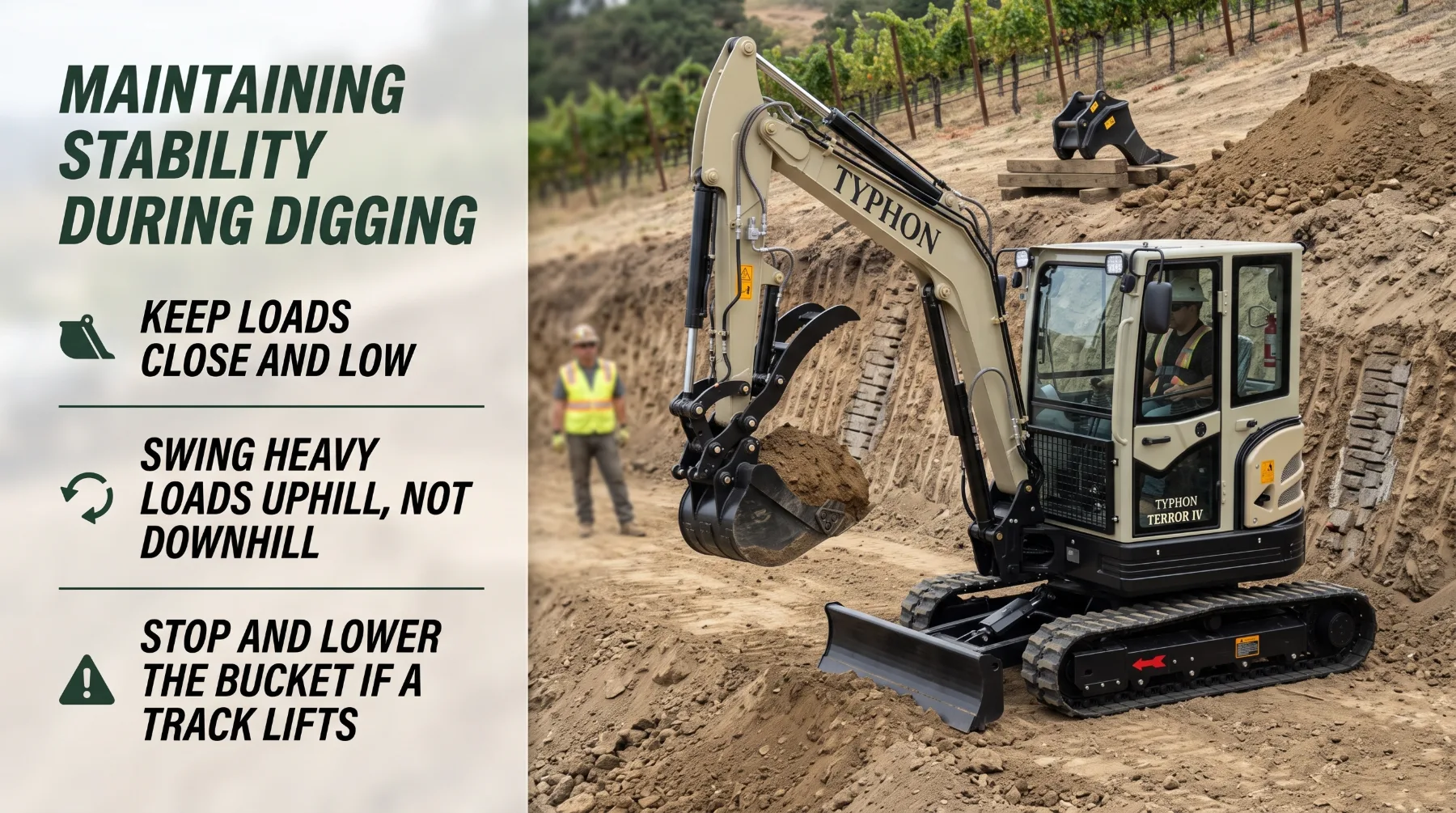
Smooth, controlled operation protects stability. Avoid sudden boom, arm, and swing movements, since abrupt starts and stops create momentum that can shift the machine. Keep loads close to the machine and low during swing. Whenever possible, swing loaded buckets toward the uphill side or straight back, and place spoil where the swing doesn’t carry heavy loads downhill. Avoid excessive side loading, such as using the bucket to pry sideways against a trench wall or drag material across the slope.
Pay attention to what the machine tells you. A track that lifts, a cab that tilts, or a sudden lurch during a swing are warnings to stop immediately, lower the bucket to the ground, and reassess. Fasten the seat belt every time you operate, since the rollover protective structure only protects an operator who stays inside it. Never override inclination alarms or warning systems, and never work outside the approved slope limits for the configuration you’re running.
Key takeaway: Boom extension, digging resistance, bucket load, and orientation all shift the excavator’s balance on a slope, so make smooth movements, keep loads close and low, avoid downhill swings and side loading, and stay within approved slope limits.
Visibility and Ground Conditions
Steep terrain hides hazards. Vegetation, uneven surfaces, loose soil, and changing weather can conceal cracks, seeps, voids, and buried objects around a sloped excavation. The operator’s view from the cab is often limited as well, since the bucket may drop below the line of sight when digging downhill or into a deep keyway.
Before digging, operators should walk the area and check for erosion, tension cracks along the crest, water flow, seeps, and signs of past ground movement such as tilted trees or bulging soil. Look above the work area for loose rocks or debris that could roll down onto the machine or crew. These checks should be repeated after rain, freeze-thaw cycles, and any long pause in work, because a slope that was firm in the morning can soften by afternoon.
Buried services demand the same attention. Contact your local one-call locating service before any excavation, which you can reach by calling 811 in the United States, and wait for every utility owner to respond. Public locating services usually don’t mark private lines, such as irrigation mains, site lighting, or service lines to outbuildings, so ask the property owner and arrange private locating where needed. Expose lines by hand or vacuum excavation within the marked tolerance zone before the bucket approaches. Look overhead too, and keep at least the clearance required by applicable regulations from power lines, which in the United States is generally at least 10 feet for lines up to 50 kV.
A spotter may be needed when the bucket or the excavation edge is difficult to see from the cab. Position the spotter safely outside the swing radius and away from the downhill side of the machine, and agree on hand signals or radio calls before work starts. Stop all movement whenever the spotter signals or anyone enters the work area. Keep the cab glass, mirrors, and cameras clean so the operator sees as much as possible directly.
Key takeaway: Inspect the slope for cracks, seeps, erosion, buried services, and overhead hazards before and during work, and use a trained spotter whenever the bucket or excavation edge is hard to see from the cab.
Planning Safe Excavation Sequences
The order in which a slope is dug matters as much as how each bucket is filled. A safe excavation sequence accounts for slope geometry, soil conditions, drainage, access routes, and the intended final profile. It decides where the machine sits at each stage, how material comes out, and where it goes.
Start with the final shape and work backward. Identify the benches, keyways, footings, and swales the design requires, then divide the excavation into segments that each fall comfortably within the machine’s working envelope. Many crews work from the top of the slope down, keeping the machine on firm, uncut ground above the active face. Plan access routes so the machine can move between segments without crossing fresh cuts or traveling across the grade.
Operators should avoid undermining the ground supporting the machine. Never dig beneath or toward the tracks, and keep the cut face a safe distance from the bench edge. Spoil placement belongs in the plan as well. Keep spoil at least 2 feet from excavation edges, or farther where the engineer requires, and never pile it at the crest of a slope where its weight can trigger a failure. Stage it where the swing carries loads uphill or back rather than downhill.
Water control often decides whether a slope stays stable. Divert runoff away from the cut before excavation begins, manage seeps as they appear, and cover exposed faces before rain when practical. Where required, a qualified person should assess slope stability and protective measures before work proceeds. When workers must enter a trench or keyway, a competent person should evaluate it, and in the United States, trenches 5 feet deep or more generally require a protective system such as sloping, shoring, or shielding unless dug entirely in stable rock. Follow the site-specific excavation plan, and stop and reassess whenever conditions differ from it.
Key takeaway: Plan the excavation in segments that fit the machine’s working envelope, work from stable ground, never undermine the excavator’s support, control water, and follow the site-specific plan with qualified assessment of slope stability.
Conclusion
Excavator digging reach can improve productivity on steep terrain, but safe and efficient performance depends on ground stability, machine positioning, bucket load, visibility, and the manufacturer’s operating limits. Published reach figures are based on specified conditions, so operators should consult the working range diagram and lift chart for their exact boom, arm, and bucket configuration and verify distances and elevations at the jobsite. A firm, level bench positioned safely back from the crest provides a stable working platform, while suitable mats can help distribute machine loads on softer ground when approved for the conditions. Before excavation, inspect the slope for cracks, water seepage, erosion, loose rock, and signs of ground movement, and reassess conditions after heavy rain. Confirm the manufacturer’s slope limits and approved machine orientation, plan a controlled excavation sequence, and avoid overreaching or carrying loads beyond the machine’s rated capacity. Smooth hydraulic movements, manageable bucket loads, and careful swing positioning help maintain control, while suitable attachments support efficient digging in resistant soil. Before starting, contact the utility locating service, arrange private locating where needed, and expose underground lines safely within designated tolerance zones. Plan spoil placement at least 2 feet from excavation edges where applicable, keep materials clear of downhill swing paths, and manage runoff to reduce erosion. A trained spotter should assist where visibility is restricted, and a qualified person should assess slope stability and required protective measures when necessary. Combining accurate reach measurements, stable positioning, utility checks, and ongoing ground assessment helps reduce risks, maintain excavation accuracy, and support reliable project progress on steep terrain.
Frequently Asked Questions
Why does digging reach matter on steep terrain?
It helps determine whether the bucket can access the work area without frequent repositioning. On a slope, however, usable reach often differs from the level-ground figure, and longer reach increases the leverage acting on the machine. Measure real distances and elevations, and plan additional setups rather than stretching to the limit.
Can an excavator work at its maximum reach on a slope?
Not automatically. The safe working envelope depends on the model, slope, ground conditions, machine orientation, and load. Lifting capacity and stability decrease toward the outer edge of the envelope, so most productive and stable digging happens closer to the machine.
What conditions make steep-terrain excavation risky?
Loose soil, erosion, wet ground, unstable edges, hidden utilities, and excessive boom extension can all increase risk. Downhill swings with heavy loads, spoil placed at the crest, and digging toward the machine’s own support also create serious hazards.
How can operators improve excavation safety on slopes?
They should assess ground stability, maintain safe setbacks, follow manufacturer limits, and use a planned excavation sequence. Keeping loads moderate and close to the machine, swinging toward the uphill side, controlling water, and using a spotter when visibility is limited all add further protection.