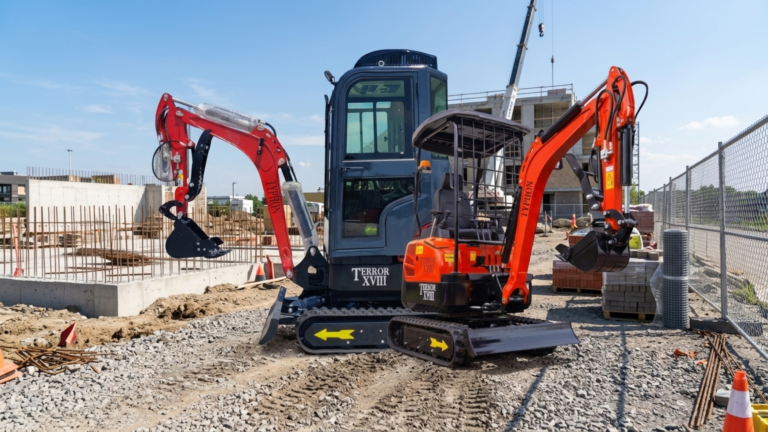

Working beside a building can turn a simple trenching job into a clearance problem when a fence, wall, and parked equipment leave little room around the machine. A conventional mini excavator can make the situation harder because its rear counterweight extends beyond the track width during rotation. Each time the operator swings the upper structure to place a bucket of spoil, the tail moves toward nearby obstacles. In a confined work area, even a small clearance mistake can damage a wall, fence, vehicle, or other site property. The operator may then need to slow down, reposition repeatedly, or leave part of the available workspace unused.
Zero tail swing addresses this rear-clearance challenge by keeping the back of the upper structure within, or very close to, the track footprint as the machine rotates. That compact swing profile gives the operator more usable space around the excavator and makes it easier to work alongside structures or other obstacles. It does not remove every jobsite hazard, but reducing rear overhang can make rotation more practical where a conventional counterweight would create a constant clearance concern.
For narrow work areas, the benefit extends beyond simple rear clearance. Machine width, boom positioning, swing range, travel path, and the location of nearby structures all affect how effectively the excavator can use a confined space. A compact rear profile can allow the machine to position closer to obstacles while leaving more room for workers, equipment, and material handling around it. Understanding how these dimensions work together helps operators use zero tail swing capability without overlooking the other clearance requirements of the job.
Improving Side Clearance
Rear overhang gets most of the attention, but side clearance is just as important on a crowded jobsite, and it shapes how a machine can be positioned in the first place. When space to the side is limited, a bulky rear profile restricts where the operator can set up and how the machine can rotate without swinging into something. A compact rear profile eases that constraint, allowing the machine to swing through its arc while keeping closer clearance from whatever sits nearby. The practical result is that the machine needs less total space to complete the same task.
That reduced footprint matters more than it might seem. On a narrow strip between a building and a property line, or in a corridor bounded by parked equipment and stockpiled material, every inch of clearance counts. A machine that can rotate within a tighter envelope gives the operator more options for where to sit and how to attack the work, and it reduces the number of times the machine has to be shuffled to a new position. Less repositioning means less wear, less fuel burned idling and tracking, and more time spent actually digging. For contractors, that efficiency in confined spaces is a direct benefit to the schedule.
Key takeaway: A compact rear profile reduces the total space a machine needs to swing, giving operators more positioning options and cutting the constant repositioning that eats into confined-space jobs.
Accessing Narrow Work Areas
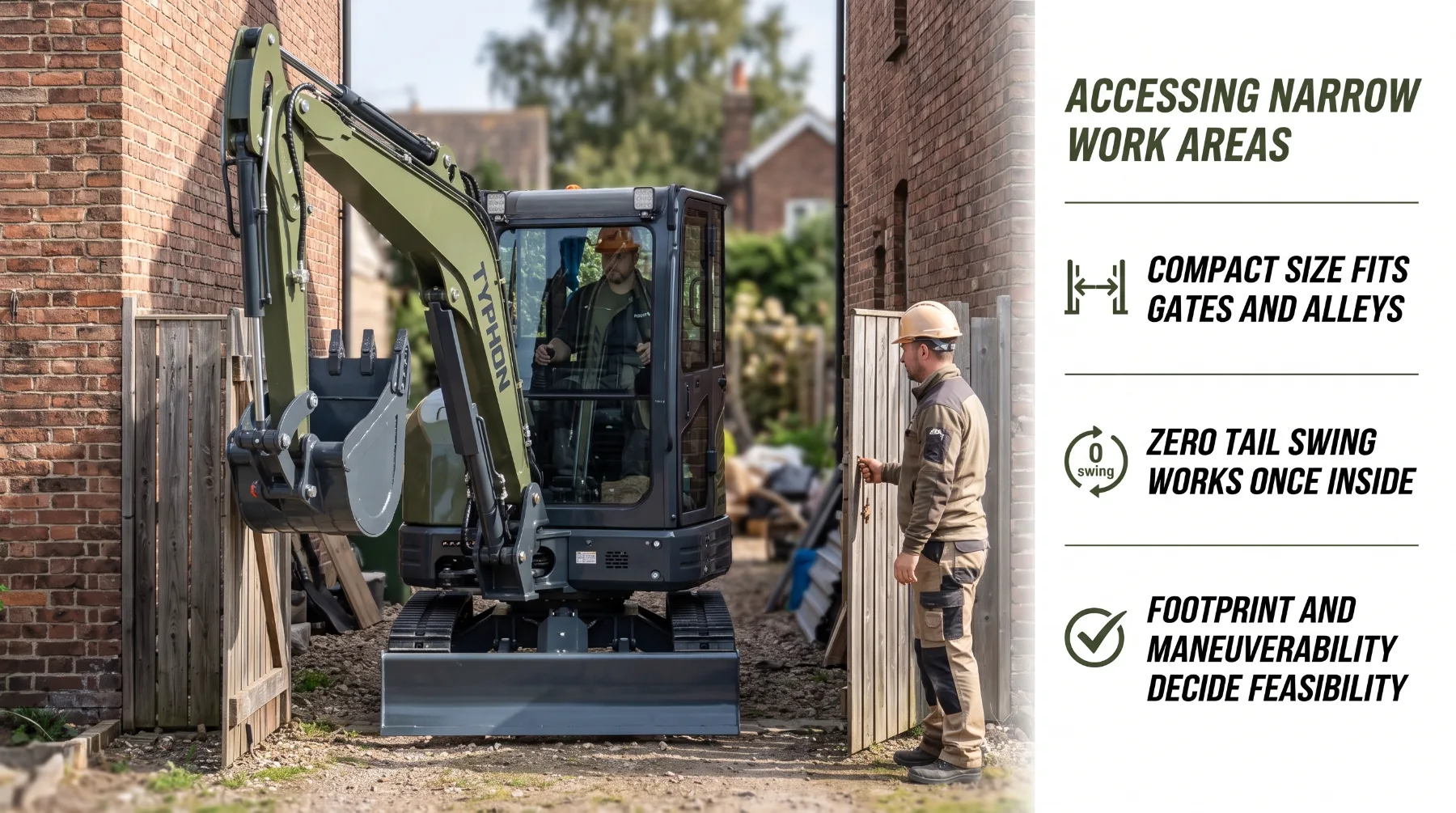
Before a machine can work in a tight space, it has to get there, and access itself is often the hardest part of a confined job. Gateways, alleys, backyard entrances, and cramped construction zones routinely stop larger equipment at the property line. A compact excavator with zero tail swing is frequently the machine that can thread through where others cannot, reaching work areas that would otherwise call for hand digging or a much larger, more disruptive setup.
Picture a backyard drainage project reached only through a standard garden gate, or a trench in a service alley barely wider than the machine itself. In these situations, the compact overall size gets the machine in, and the zero tail swing design lets it work effectively once it arrives. The two qualities complement each other: compact dimensions solve the access problem, and the minimal rear overhang solves the working-space problem on the other side of the gate. This combination is why so many residential and urban contractors rely on these machines for jobs where footprint and maneuverability decide whether the work is even feasible.
Key takeaway: Compact dimensions paired with zero tail swing let a mini excavator reach and work in narrow areas like gateways, alleys, and backyards where larger machines simply cannot go.
Supporting 360-Degree Rotation
A mini excavator earns much of its value from full rotation, the ability to swing the upper structure a complete circle to dig, spoil, and load from almost any angle. Zero tail swing preserves that full rotation while dramatically reducing the risk that comes with it in tight spaces. As the upper structure turns, the compact rear design keeps the counterweight from extending far beyond the tracks, so the operator can use the machine’s full working circle even with obstacles close behind.
That said, reduced rear overhang is not the same as no clearance concern, and this is where discipline still matters. The boom, the bucket, and the front of the house all move through space as the machine rotates, and they demand attention just as much as the tail ever did. A responsible operator monitors the complete swing area, not only the rear, and maintains appropriate clearance from people, structures, and equipment throughout every rotation. Zero tail swing removes one major hazard, but the operator remains responsible for everything the machine sweeps through as it turns. Treating the design as an aid to good practice, rather than a substitute for it, is what keeps confined-space work safe.
Key takeaway: Zero tail swing supports full rotation with far less rear overhang, but operators must still watch the entire swing area, including the boom and bucket, and keep clearance from people and structures.
Positioning Near Structures
Much of the work that suits a mini excavator happens close to existing structures, including foundation trenches, utility runs, and excavation beside footings. Zero tail swing gives the operator more flexibility in these tight areas by reducing rear overhang during rotation. However, the operator still needs to monitor the boom, counterweight, bucket, and attachment throughout each movement to maintain proper clearance.
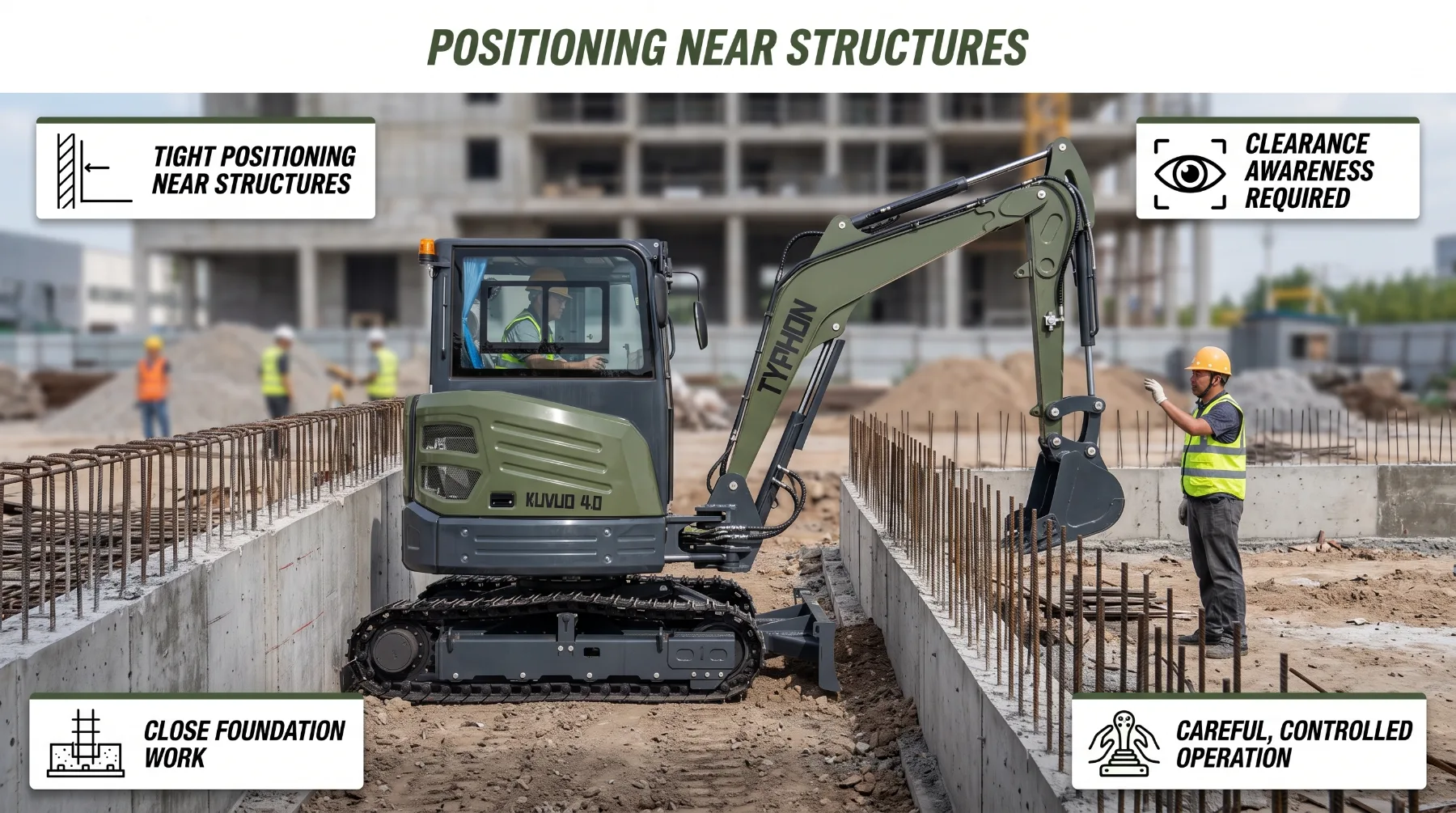
- Tight positioning: Zero tail swing allows the excavator to work closer to walls, foundations, fences, and other structures without the rear of the machine sweeping as far beyond the track footprint.
- Clearance awareness: Reduced rear overhang does not eliminate the need to check the full working area. The boom, bucket, counterweight, and attachment can still contact nearby structures.
- Close foundation work: When digging beside a foundation wall or footing, the compact rear profile helps create more usable working space for positioning and rotation.
- Careful operation: The main advantage comes from combining the machine’s compact swing profile with controlled movements and constant awareness of surrounding structures.
Key takeaway: Zero tail swing offers real flexibility for working close to foundations and structures, but the operator must still track the boom, bucket, counterweight, and attachment through every movement.
Considering Machine Width
Tail swing is one piece of the access puzzle, not the whole of it, and treating it in isolation leads to disappointment. A machine with an ideal rear profile still has to fit through the entrance, clear any height restriction, reach the required depth, and swing its attachment within the available space. Track width, overall machine height, digging reach, and attachment dimensions all combine with tail profile to determine whether a mini excavator can genuinely enter and work in a restricted area. Any one of these dimensions can be the deciding factor.
This is why sizing a machine to a confined job means looking at the complete set of dimensions against the real constraints of the site. A machine that clears a narrow gate on width might still be too tall for a covered passage, or its digging reach might fall short for a deep trench, or a wide bucket might not swing where a narrow one would. Some machines offer variable or retractable track widths precisely to balance stability against tight access, which is worth considering when the entrance is the limiting factor. The reliable approach is to match every relevant dimension to the specific job rather than assuming zero tail swing alone guarantees access. Get the full picture right, and the machine performs; miss one dimension, and even the most compact tail profile will not save the job.
Key takeaway: Zero tail swing is only one access factor, so match track width, height, digging reach, and attachment dimensions to the site alongside tail profile to confirm a machine truly fits.
Conclusion
Zero tail swing reduces rear overhang during upper-structure rotation, allowing a mini excavator to operate closer to walls, fences, buildings, and other obstacles where rear clearance is limited. Keeping the rear profile within or near the track footprint reduces the space required for rotation and can minimize repositioning on confined jobsites. When combined with compact overall dimensions, zero tail swing can improve access through narrow gateways, alleys, and residential work areas, while still allowing the upper structure to rotate through its designed range. However, the reduced rear profile does not eliminate clearance requirements around the boom, arm, bucket, counterweight, tracks, or attachments, and the actual working envelope depends on machine width, height, reach, attachment dimensions, and operating configuration. Operators must therefore monitor the complete swing and working area rather than relying on the tail profile alone. Before selecting a zero tail swing mini excavator, access routes, working clearances, ground conditions, required reach, and attachment dimensions should be compared with the manufacturer’s machine specifications. Evaluating the complete operating envelope allows the machine to take advantage of its reduced rear clearance while maintaining appropriate separation from surrounding structures and obstacles.
Frequently Asked Questions
What does zero tail swing mean?
Zero tail swing means the rear of the excavator’s upper structure stays within or very close to the track footprint during rotation. Unlike conventional excavators, the counterweight does not swing far beyond the tracks. This allows the machine to rotate closer to walls, fences, and buildings. Check the specific model’s clearance, since zero, near-zero, and reduced tail swing designs can vary.
Why is zero tail swing useful?
Zero tail swing allows excavators to work closer to walls, fences, buildings, and other obstacles where rear clearance is limited. It reduces the risk of the counterweight striking nearby objects and can reduce repositioning in confined areas. This makes tasks such as foundation work, utility trenching, and landscaping more practical in tight jobsites.
Does zero tail swing mean the machine can operate anywhere?
No. Zero tail swing only addresses rear clearance during rotation. The boom, bucket, tracks, and attachments still require adequate space, and operators must consider overhead obstacles, ground conditions, people, and access routes. It improves maneuverability but does not remove other clearance or operating hazards.
Is machine width important for narrow access?
Yes. Overall machine width often determines whether an excavator can pass through a gate, side passage, or doorway. Height, digging reach, attachment size, and tail profile also affect access. Some machines offer variable track widths to improve access while providing a wider base for work. Always compare the machine’s dimensions with the narrowest point on the jobsite.