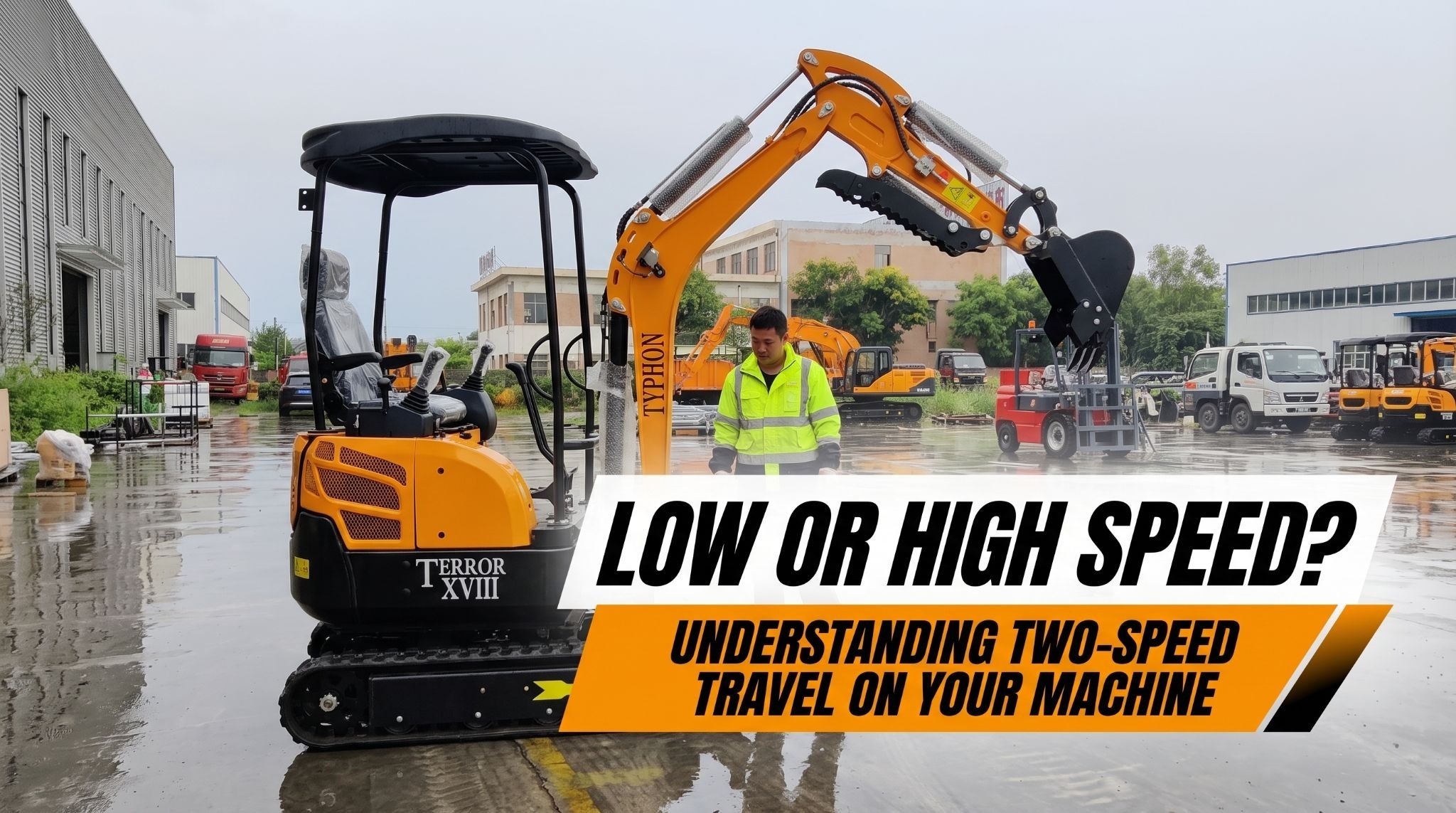
Picture an operator finishing a section of trench, lifting the blade, and needing to cross fifty feet of open, compacted ground before starting the next dig. The machine is in low speed. It crawls. The move that should take ten seconds takes thirty. Multiply that by dozens of repositioning trips across a full shift, and a significant portion of productive time disappears into something that had an easy fix. That fix is the two-speed travel switch, and knowing when and how to use it is one of the simplest ways to get more from a mini excavator every single day.
Two-speed travel is not a complicated system, but it rewards operators who understand what it actually does, why the trade-off between force and pace exists, and how to read a situation before making the switch. This post covers all of it clearly, from the mechanics behind the system to the habits that make speed selection second nature on any site.
What the Two-Speed System Actually Does
Every mini excavator moves on its tracks through a pair of hydraulic travel motors, one behind each track. These motors receive pressurized hydraulic fluid from the machine and convert that flow into the rotational force that drives the sprockets and pulls the tracks forward or backward. Two-speed travel gives those motors a choice between two distinct operating modes, selected by the operator with a single control.
At its core, the system works by changing how the motor uses the hydraulic flow it receives. In low speed, the motor is configured to extract maximum rotational force from that flow, which produces strong torque at the track but limits how fast the sprocket turns. In high speed, the internal configuration shifts so the same volume of fluid produces faster rotation, allowing the machine to travel more quickly but with less force available at the track. The hydraulic output from the engine does not change between these modes. What changes is how the motor converts that output into motion. More torque in one direction, more speed in the other, with the same energy behind both.
A simple analogy helps here. Think of the gears on a bicycle. A low gear multiplies your pedaling force so you can climb a hill without exhausting yourself, while a high gear converts that same effort into faster forward movement on flat ground. The legs supply the same energy regardless. The gears decide how it gets applied. Two-speed travel works on the same principle, and once that relationship is clear, the logic behind every speed decision becomes easy to follow.
The Case for Low Speed and Why Torque Matters
Low speed earns its keep the moment the job requires the machine to push, pull, or hold against resistance. Torque is what allows a mini excavator to do all three, and low speed is the setting that delivers it in full.
Consider what happens during digging. As the bucket cuts into the ground and the arm draws material back, the machine often needs to edge forward steadily to keep pace with the work. That forward movement has to overcome the drag of the material, the resistance of the ground, and the weight of the loaded attachment working at the end of the arm. In low speed, the tracks press forward with authority, maintaining the operator’s position without wandering or spinning out. Switch to high speed in the same situation and the torque drops, the machine loses grip, and the whole digging rhythm falls apart.
Slope work reveals the same principle in a different setting. Climbing a grade under any significant load asks the travel motors to overcome both rolling resistance and gravitational pull simultaneously. Low speed provides the sustained torque needed to keep the machine climbing steadily rather than slipping or stalling. The same benefit applies on the descent, where the higher torque of low speed gives the operator more authority over the machine’s pace, preventing the tracks from running ahead of the controls.
Soft or compromised ground adds one more reason to favor low speed. Mud, loose fill, clay, and rutted terrain all reduce the traction available at the track surface. By delivering more rotational force, low speed helps the tracks maintain grip and continue moving even when the surface provides little natural resistance. The machine pushes through rather than sitting and spinning, which keeps the job moving and reduces the risk of getting stuck on ground that looked passable at first glance.
When High Speed Becomes the Right Call
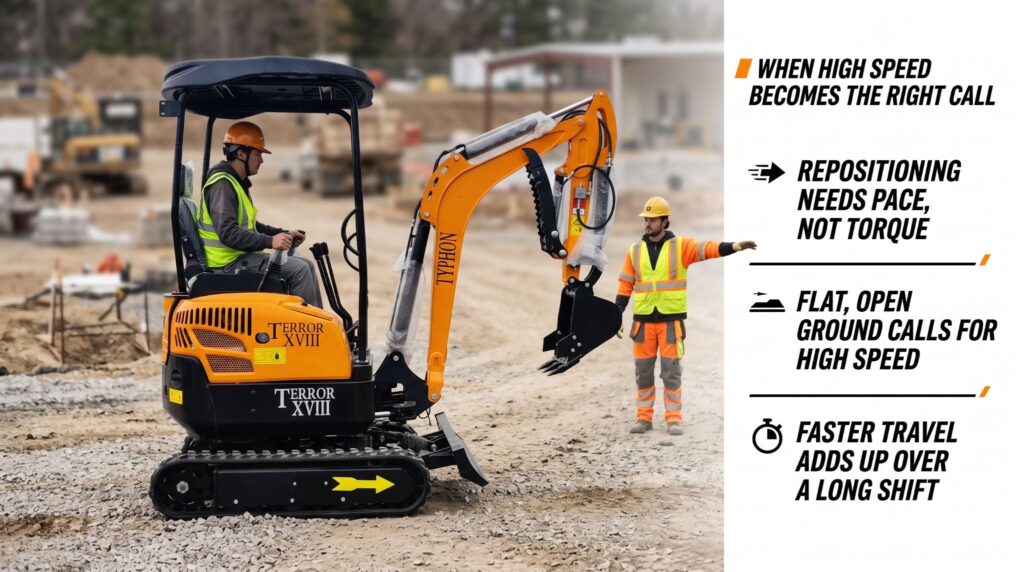
Repositioning is a fact of life on any active job site. Machines move between tasks, travel from unloading points to work areas, shift along a trench line, and navigate across cleared ground dozens of times each day. None of that movement requires force. It simply requires getting from one point to another, and doing it quickly is always better than doing it slowly.
High speed was designed for exactly these moments. On firm, flat, open ground with no material to resist and no grade to climb, the torque advantage of low speed contributes nothing. The machine is just traveling, and what serves the operator is pace. Switching to high speed before setting off on a repositioning run can cut the time in half, and those recovered minutes accumulate into real productivity across a long shift.
The key condition for high speed is that the ground underfoot must be solid and the path must be clear. Soft patches, unexpected grades, and obstacles all change the calculation immediately. High speed is not a setting to maintain out of habit; it is a deliberate choice made when the conditions genuinely support it. Used correctly on the right terrain, it is one of the most efficient habits an operator can develop.
The Trade-Off at the Heart of the System
Understanding why the machine cannot simply offer maximum torque and maximum speed at the same time requires understanding the nature of hydraulic power. The engine produces a fixed volume of hydraulic flow, and the travel motor has to do something with it. More torque means the motor works harder against each unit of flow but turns more slowly. More speed means the motor turns faster but generates less force per rotation. Both results come from the same input, and the motor can only favor one direction at a time.
This is why operators who try to use high speed in demanding conditions tend to find the machine unresponsive or unstable. Attempting to climb a loaded slope in high speed asks the tracks for more grip than the reduced torque can provide. The machine may slow dramatically, stall, or lose directional control depending on the severity of the demand. Many modern mini excavators include an automatic downshift function that detects high resistance and drops back to low speed without waiting for the operator to intervene, but that safety net is designed as a last resort, not a substitute for reading the situation correctly in the first place.
The same logic works in reverse. An operator who stays in low speed across an open, flat site is not damaging anything, but they are spending time inefficiently. The torque that makes low speed so valuable on difficult ground offers no benefit on terrain that presents no resistance, and every slow crossing across clear ground is a small, avoidable cost.
How to Make the Switch Work for You
Good speed selection starts before movement begins rather than in the middle of it. Operators who plan their switch a moment ahead avoid the awkward mid-movement correction that comes from realizing mid-path that the terrain or task has changed. Before traveling, consider the ground ahead, the distance, and whether any resistance is likely along the way. Before digging, grading, or climbing, confirm low speed is engaged so the torque is ready the instant the machine meets resistance.
On most mini excavators, the two-speed control sits on the dozer blade lever or a dedicated travel control button, positioned for easy access without requiring the operator to look away from the task. Locating it by feel during a quiet moment early in the day means it will always be there when needed. Some machines place it differently depending on the manufacturer or model year, so reviewing the manual for any unfamiliar machine is always time well spent.
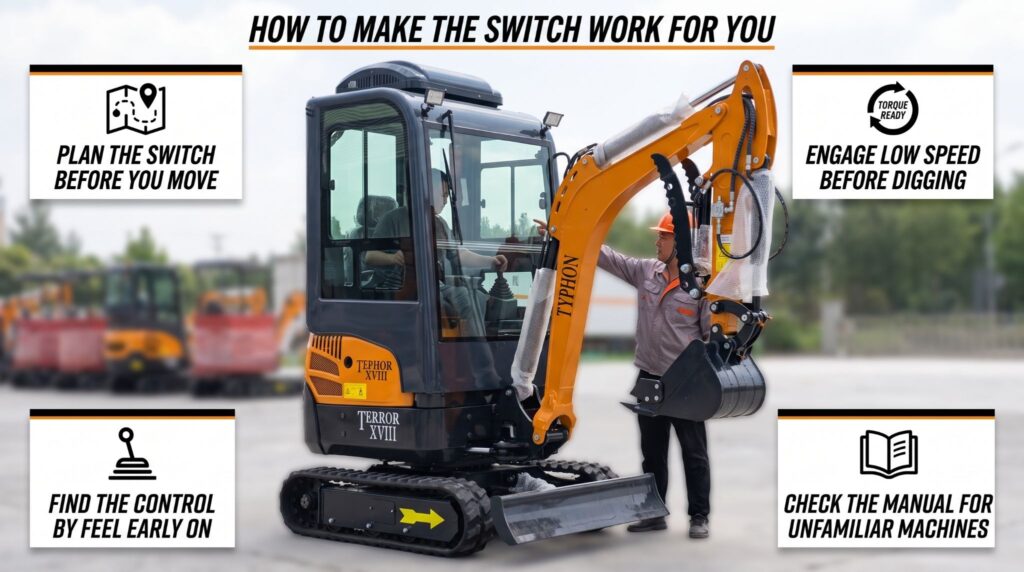
Building a consistent default also simplifies the decision across a busy shift. Many experienced operators settle into a habit of starting every task in low speed and switching to high only during unloaded travel on confirmed solid ground. This default protects traction and control in any situation that might be more demanding than it looks, and it ensures the machine is always ready to work the moment the operator reaches the next position. The habit costs nothing when the ground is easy and saves real trouble when conditions turn out to be trickier than expected.
Putting It All Together on the Job Site
Two-speed travel is a small feature with an outsized effect on your day. Low speed gives you the torque and traction to dig, climb, grade, and push through tough ground with steady control. High speed gives you the quickness to cross open sites and reposition without wasting time. Neither is better than the other; each is the right tool for a different moment, and the skill lies in knowing which moment you’re in.
Once you understand the trade-off between force and speed, the choice stops feeling like a guess and starts feeling automatic. You’ll reach for low speed when the ground fights back and high speed when the path is clear, and your machine will reward you with better performance, less wear, and more work accomplished in every shift. Master that simple switch, and you’ll get the full value out of the mini excavator you depend on.
Conclusion
Two-speed travel is one of those features that rewards operators who take the time to understand it. The mechanics are straightforward, the trade-off is logical, and the benefit is immediate: the right speed setting at the right moment means your machine works harder, moves smarter, and lasts longer. Low speed when the job demands force. High speed when the path is clear. That one habit, applied consistently, is the difference between a machine that just runs and a machine that truly performs. Take the time to know your controls, read the conditions, and make the switch with intention. Your productivity and your equipment will show it.
Frequently Asked Questions
Can using the wrong travel speed damage my mini excavator or hurt performance?
Using the wrong speed can reduce traction, increase strain, and make the machine harder to control. High speed on slopes, soft ground, or under heavy loads can cause slipping or bogging. Match the speed to the terrain and workload for safer, smoother performance.
When should I use high speed on my mini excavator?
Use high speed for traveling across flat, firm ground, repositioning the machine, or moving between work areas. It saves time when extra track torque is not needed.
When should I use low speed on my mini excavator?
Use low speed for digging, trenching, grading, climbing slopes, or traveling over soft or uneven ground. It provides more track torque, control, and traction when the machine needs extra power.