
Picture a warehouse supervisor watching two identical forklifts work side by side through a morning shift. Both trucks started the day with a full charge, and both carry the same load on the same route. By mid-afternoon, one truck is lifting pallets with the same authority it had at 7 a.m. The other is visibly slower, its lifts labored and its travel speed reduced to something the operator has learned to work around. The batteries in those two trucks may have promised the same runtime, yet they are delivering completely different results. That gap is what this comparison is about. Runtime tells you when a battery runs out. Power delivery tells you how well it performs before that happens, and understanding the difference is what guides a smart forklift battery decision.
Why Power Delivery Shapes Operator Experience
A forklift does not draw electricity in a smooth, even stream. It surges. Every lift, every acceleration, and every ramp climb pulls a large burst of current in a short window, then drops back to almost nothing during travel or idle. The battery’s job is to meet those surges without hesitation, and the quality of that response is what operators feel behind the controls throughout the shift. Runtime figures say nothing about this. A battery can still hold a meaningful charge yet deliver noticeably weaker performance because of how it manages those demands under load. The supervisor watching two trucks diverge in the afternoon is not watching one run out of energy before the other. She is watching one hold its performance while the other quietly fades. That is the story power delivery tells, and it is the story runtime numbers leave out entirely.
Voltage Consistency Through the Discharge Cycle
Voltage is the force that drives a forklift motor, and the steadier it stays, the more consistent the truck feels across the full length of a shift. Lead-acid batteries discharge along a gradual, continuous downward slope. A fully charged pack performs well in the morning, but by midday the voltage has dropped enough to slow lifts and reduce travel responsiveness. By late afternoon, the operator is working with a machine that has quietly lost a measurable share of its capability. The energy still registers on the gauge, but the power behind it has thinned.
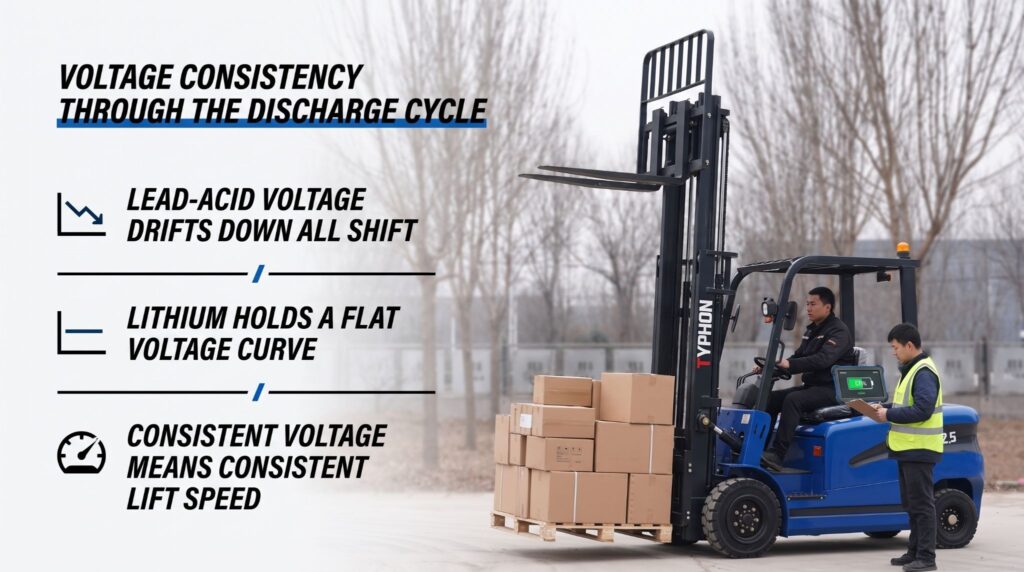
Lithium-ion cells hold a far flatter discharge curve. From roughly eighty percent charge down to twenty percent, the voltage stays within a tight range, which means the forklift delivers consistent lift speed and travel force throughout most of the cycle. The truck that felt capable at the start of the shift still feels capable several hours later, because the motor is receiving nearly the same voltage it received at full charge. For operations running through long shifts or tight scheduling windows, that consistency changes what operators can rely on and what supervisors can plan around.
How Each Battery Handles Peak Demand
A pallet at full weight does not ask gently. When an operator raises a loaded fork, the hydraulic system draws a concentrated burst of current that stresses the battery far beyond its average load. Lead-acid chemistry handles this with higher internal resistance, which causes a temporary dip in voltage precisely when the demand spikes. Later in the shift, when the battery is already partially depleted, that dip becomes more pronounced. The operator feels the hydraulics slow, the lift hesitates, and the truck seems to struggle under a load it handled easily hours earlier.
Lithium-ion cells carry lower internal resistance and handle high-current bursts with substantially less voltage sag. When an operator lifts a heavy pallet or accelerates sharply, the battery responds without the same momentary drop. Across a high-throughput operation cycling thousands of moves in a shift, the difference in cycle time per lift compounds into a measurable productivity gap. Facilities where seconds matter, loading docks moving time-sensitive freight or distribution centers running against tight schedules, feel that advantage directly in their throughput numbers.
Performance Through the End of the Cycle
The final portion of a battery’s discharge reveals a lot about its design. Lead-acid voltage falls slowly and continuously, which means there is no clear signal to an operator that performance is degrading. The truck still moves, the forks still rise, but the machine is running well below its design output. Operators frequently push through this period rather than pause to swap batteries, accepting reduced productivity as a normal feature of the late shift rather than recognizing it as a problem the battery choice created.
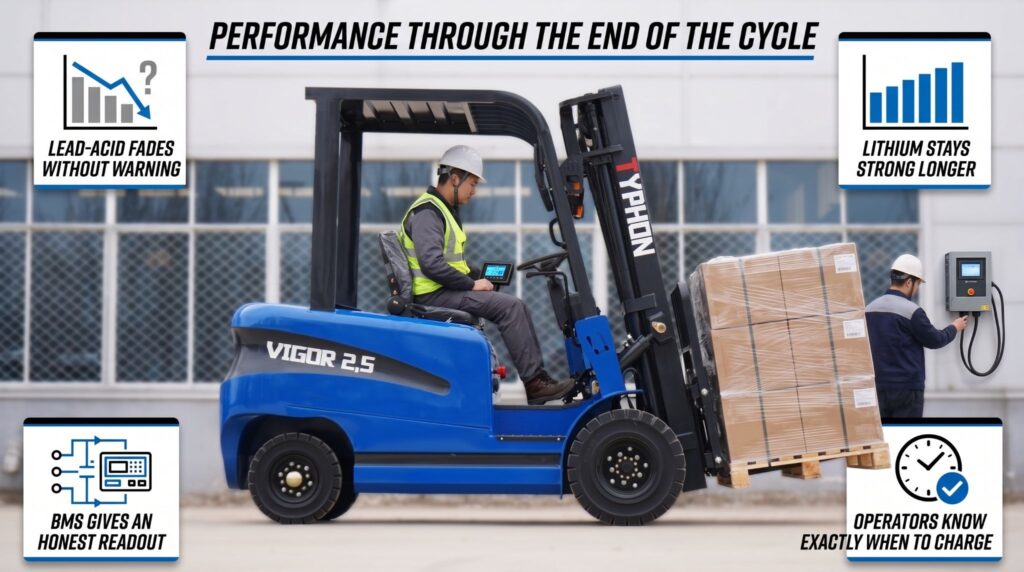
Lithium-ion batteries reach the end of their usable range differently. Performance stays strong and stable across most of the cycle, then falls off steeply only near the very bottom of the charge. The battery management system provides an accurate, honest readout of remaining capacity, so operators know precisely when a charge is needed rather than guessing by how sluggish the machine has become. That clarity removes the guesswork from shift planning and ensures the truck delivers its full capability right up until the appropriate charge point.
Thermal Behavior and Charging Requirements
Heat accumulates inside both battery types during use and charging, but the two chemistries produce and manage it in different ways. Lead-acid packs generate significant heat under heavy discharge and during charging, especially when pushed through intensive cycles. That heat accelerates water loss from the electrolyte and contributes to plate wear over time. Charging also releases hydrogen gas, which is why lead-acid fleets require dedicated, ventilated charging rooms designed to manage that off-gassing safely.
Lithium-ion batteries generate less heat during normal operation and carry a battery management system that actively monitors cell temperature and regulates both charging and discharging to keep the pack within a safe thermal range. They do not off-gas, which removes the need for a dedicated ventilated charging area and simplifies facility planning. Cold-storage applications require attention, since lithium cells have low-temperature limits and may need heating systems or cold-rated specifications to perform reliably. For standard ambient warehouse conditions, however, the thermal behavior of lithium-ion supports both consistent daily performance and longer overall battery life.
Charging behavior also separates the two technologies at an operational level. Lead-acid packs require a complete, uninterrupted charge cycle followed by a cool-down period, and partial top-ups shorten their service life considerably. Multi-shift operations running lead-acid typically invest in spare batteries and the infrastructure to swap them, including lifting equipment, floor space, and labor. Lithium-ion batteries accept partial charges at any state without damage, allowing operators to add meaningful energy during breaks or shift changes without stopping the truck for a full cycle. That flexibility often eliminates spare batteries and swapping routines entirely, simplifying the operation and reducing the labor and floor space those routines demand.
Total Cost and Matching the Right Battery to Your Operation
Purchase price is the number that makes lead-acid appealing at the outset. The upfront cost is lower, and for operations with limited capital budgets or less intensive daily demands, that lower entry point is a legitimate advantage. A single-shift facility with predictable rest periods built into the schedule can charge overnight, run through the day on a full battery, and repeat that cycle reliably without the investment lithium-ion requires.
The full financial picture shifts when you account for the entire working life of the battery rather than the initial invoice. Lithium-ion packs last significantly longer, complete many more charge cycles, and require virtually no routine maintenance. There is no electrolyte to water, no equalization charging, and no dedicated maintenance schedule. Charging efficiency is higher, which lowers energy costs over time, and the elimination of spare batteries and swapping infrastructure removes both capital and ongoing labor expense. When downtime carries a real cost, whether from missed shipping windows, reduced throughput, or extra labor to manage swaps, lithium-ion’s operational advantages compound across every shift, every week, and every year of the fleet’s service life.
The right battery depends on the demands of your specific operation. Lead-acid serves well where usage is moderate, schedules allow full charge cycles, and the initial investment drives the decision. Lithium-ion earns its premium where forklifts run hard, shifts overlap, and consistent performance from first lift to last defines what the operation needs to function. Defining your actual workload honestly is the first step toward a decision that serves your fleet for the long term.
Conclusion
Runtime is an easy number to compare, but it was never the number that mattered most. Power delivery is what your operators feel every hour of every shift, and it is what determines how much work your forklifts actually accomplish. Lead-acid remains a reliable, affordable performer for the right operations, while lithium-ion delivers the steady voltage, peak responsiveness, thermal stability, and charging flexibility that high-demand operations depend on. Look past the runtime figure, understand how each battery behaves under real load, and weigh the full cost across its working life. Make the comparison on those terms, and you will choose a battery that keeps your operation moving with confidence, shift after shift.
Frequently Asked Questions
Is lithium-ion worth the higher upfront cost for my forklift fleet?
Often, yes. Lithium-ion batteries cost more upfront but typically last longer, charge more efficiently, and require less maintenance. For high-use fleets, opportunity charging can also reduce downtime and eliminate the need for spare batteries.
How does temperature affect lithium-ion versus lead-acid forklift batteries?
Lead-acid batteries can lose capacity in cold conditions and overheat during charging. Lithium-ion generally performs more consistently across a wider temperature range, but cold-storage users should confirm the battery supports low temperatures or has a heating system.
Can I switch from lead-acid to lithium-ion batteries without modifying my forklift?
Often, yes, if the lithium battery matches the forklift’s voltage and size requirements. However, compatibility varies by model, and some forklifts may need software or battery-management updates. Always confirm with the dealer or battery supplier before switching.