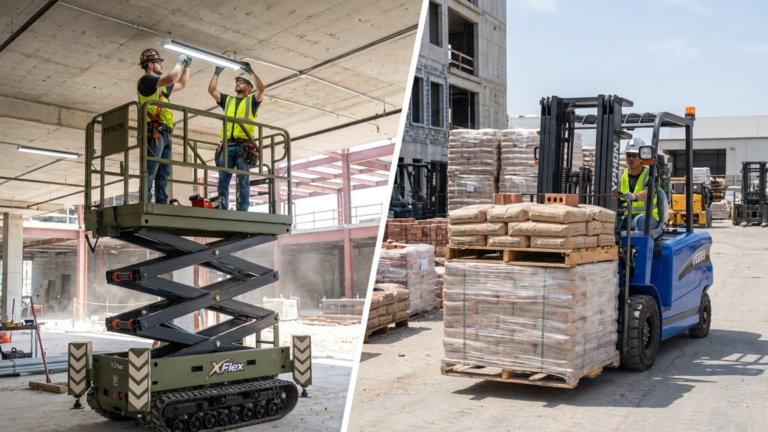
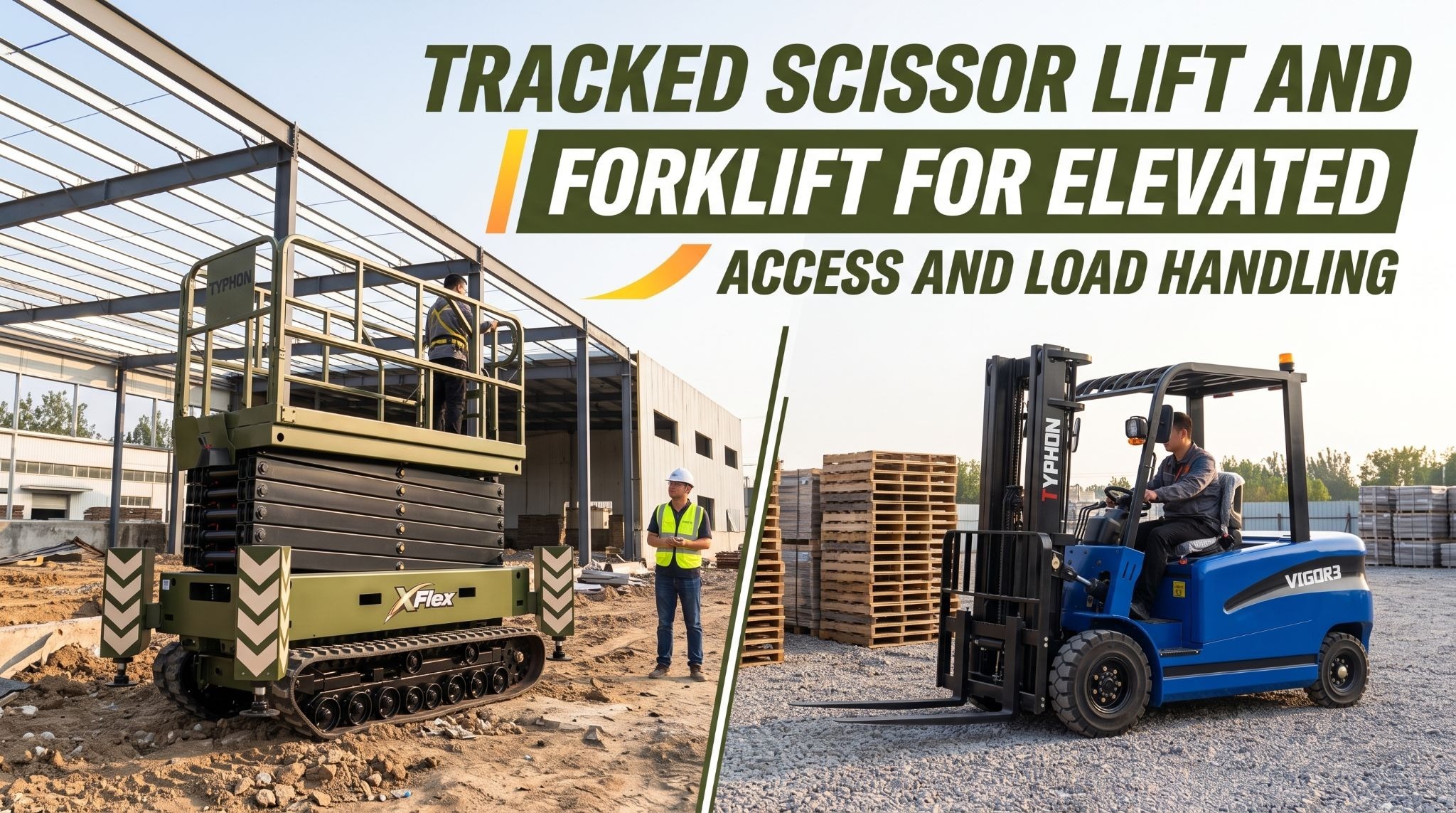
A job site often needs two very different jobs done at height: getting people and tools safely up to work on a wall, ceiling, or structure, and moving heavy loads quickly from one point to another. It’s tempting to think one machine can cover both, but a tracked scissor lift and a forklift are built around fundamentally different goals. One raises a stable platform so workers can labor at height with both hands free; the other lifts and carries loads with speed and muscle. Choosing between them, or knowing when you need each, starts with understanding that elevated access and load handling are not the same task, even though they both involve lifting.
The stakes here are practical and financial. A machine matched to the wrong job wastes money, slows the work, and can create safety risks the equipment was never designed to handle. Send a forklift to do a scissor lift’s work and you compromise the safety of people at height; send a scissor lift to move pallets all day and you’ll watch productivity crawl. This post breaks down how each machine approaches its core task, where the tracked scissor lift genuinely excels, where the forklift is the clear choice, how terrain and surface shift the decision, and how to match the right machine to the demands your site places on it.
How Each Machine Approaches Its Core Task
A tracked scissor lift and a forklift both lift, but they lift for different reasons, and that difference shapes everything about how they’re built. A scissor lift exists to elevate people. Its crossed, folding leg mechanism raises a wide, guarded platform straight up, giving workers a stable, spacious deck to stand on while they work at height. The platform stays level, the railings keep the crew secure, and the whole design is oriented around letting people perform a task safely off the ground, whether that’s installing ductwork, painting a high wall, or servicing equipment overhead.
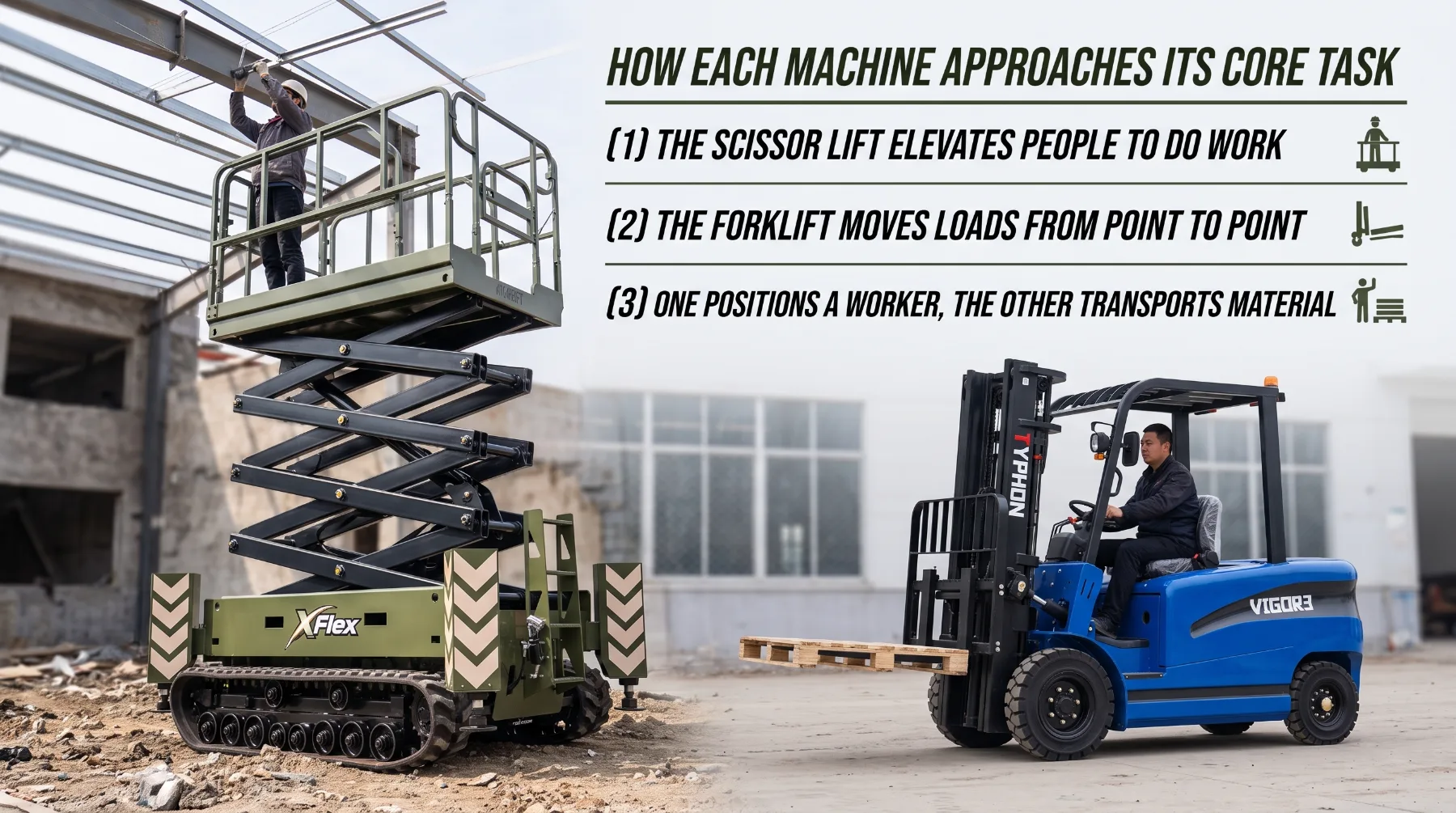
A forklift, by contrast, exists to move loads. Its mast and forks are engineered to slide beneath a pallet, lift it, and carry it wherever it needs to go, then place it precisely on the ground or high on a rack. The operator stays seated at the base, not riding up with the load, because the machine’s purpose is transporting material rather than positioning a worker. Speed, capacity, and maneuverability define a good forklift, since its value lies in how much it can move and how quickly it can move it.
This distinction matters more than it first appears. Elevated access is about keeping people safe and productive at height, while load handling is about moving weight efficiently across a site. A tracked scissor lift is optimized for the first, a forklift for the second, and understanding which task dominates your work is the foundation of every sensible choice between them.
Key takeaway: A tracked scissor lift is built to elevate people safely on a stable platform, while a forklift is built to lift and carry heavy loads quickly, so the machines suit fundamentally different tasks.
Where a Tracked Scissor Lift Excels
The tracked scissor lift earns its place wherever people must work at height on ground that a wheeled machine can’t handle well. Its rubber tracks spread the machine’s weight across a long, broad footprint, so it crosses soft turf, mud, loose gravel, and uneven terrain without sinking or tearing the surface. On outdoor construction, landscaping, and maintenance sites where the ground refuses to cooperate, that capability lets crews reach height confidently instead of waiting for the surface to firm up or dry out. The same low ground pressure protects finished lawns and delicate flooring, which matters on jobs where the surface has to survive the work intact.
Personnel elevation is where the machine truly shines. The wide, railed platform gives workers a secure, roomy deck to stand on with tools and materials close at hand, and the level base a tracked undercarriage provides keeps that platform steady even on imperfect ground. Tasks that demand both hands and a stable footing, such as electrical work, finishing, inspection, and installation at height, are exactly what a scissor lift is designed for. Where a forklift would offer no safe way to position a worker for sustained overhead labor, the scissor lift makes that work routine.
Electric tracked models add a further advantage on emission-sensitive sites. Running clean and quiet with no exhaust, they suit indoor work, occupied buildings, and locations with strict air-quality or noise requirements, all while retaining the rough-ground capability the tracks provide. For a crew that moves between demanding outdoor terrain and sensitive interiors, one electric tracked scissor lift covers both without forcing a compromise between clean operation and off-road footing.
Key takeaway: A tracked scissor lift excels at elevating people safely on soft or uneven ground, offers a stable platform for hands-free work at height, and, in electric form, works cleanly on emission-sensitive sites.
Where a Forklift Excels
The forklift is the clear choice whenever the job is moving heavy loads with speed and precision. Its mast and forks are built to handle substantial pallet weights that a scissor lift is never meant to carry, and its rated capacity across a range of load sizes makes it the backbone of material handling in warehouses, yards, and loading docks. When the day’s work is unloading trucks, feeding a production line, or shifting stock from one area to another, nothing matches a forklift’s ability to lift a load, carry it, and set it down exactly where it belongs.
Speed is a large part of the machine’s value. A forklift moves loads quickly across a site, turning tightly in aisles and covering distance between the dock and the storage area without fuss. Over a full shift, that pace translates into a volume of material moved that no platform lift could approach, because the forklift is optimized for the repeated cycle of pick up, carry, place, and return. For high-throughput operations where the measure of success is how many loads move per hour, that efficiency is decisive.
Racking work rounds out the forklift’s strengths. With the right mast, it places and retrieves pallets high on warehouse shelving, reaching top beams and stacking loads in dense vertical storage. This is a task built entirely around lifting and positioning material at height, not around putting a person there to work, which is precisely why the forklift’s mast-and-fork design fits it so well. In dense storage, fast load movement, and heavy pallet handling, the forklift does what no scissor lift can.
Key takeaway: A forklift excels at handling heavy pallets, moving loads quickly across a site, and placing or retrieving material from high racking, making it the right tool wherever material handling volume and weight dominate the work.
How Terrain and Surface Shape the Choice
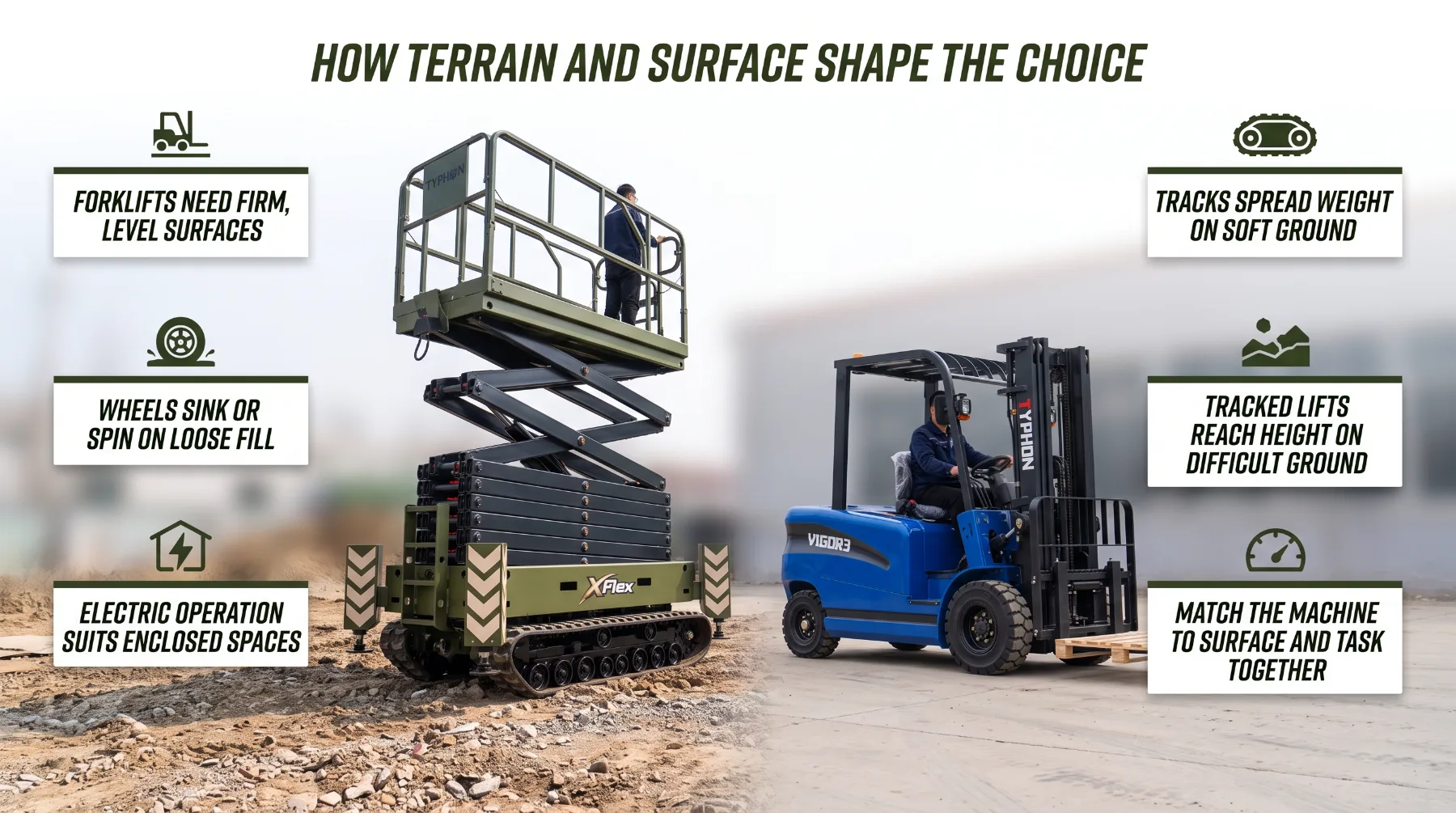
The ground a machine must work on often decides the choice as firmly as the task itself. A forklift, particularly the common warehouse type, is built for firm, level, finished surfaces. On smooth concrete floors and paved yards it moves efficiently and safely, but soft, loose, or uneven ground quickly defeats it, since its wheels concentrate the machine’s weight on small contact patches that sink into turf and spin on loose fill. Rough-terrain forklifts exist for outdoor material handling, yet they are built around moving loads rather than positioning people at height.
A tracked scissor lift is designed for the opposite challenge. Its tracks spread weight to keep the machine afloat on soft ground and grip loose or slick surfaces where wheels would struggle, so it reaches height on terrain that would stop a standard forklift or wheeled lift. That capability comes paired with a platform meant for personnel, not heavy pallets, which underscores how the two machines answer different problems. The surface question and the task question tend to point in the same direction: heavy loads on firm ground favor the forklift, while people working at height on difficult ground favor the tracked scissor lift.
Indoor and emission conditions layer onto the terrain decision. Enclosed and occupied spaces reward clean, quiet electric operation, which an electric tracked scissor lift delivers while still handling rough ground, and which many forklifts, especially combustion models, cannot match without ventilation and noise concerns. Reading both the surface and the environment together, alongside the core task, keeps the choice grounded in the real conditions the machine will face rather than a single headline capability.
Key takeaway: Forklifts suit firm, level surfaces and heavy loads, while tracked scissor lifts handle soft, uneven ground and personnel elevation, so terrain and environment usually reinforce the task in pointing to the right machine.
Conclusion
A tracked scissor lift and a forklift solve different problems, and the clearest path to the right choice is recognizing which problem you actually have. The scissor lift elevates people safely on a stable platform, excelling on soft and uneven ground and, in electric form, on emission-sensitive sites where clean, quiet operation matters. The forklift lifts and moves heavy loads with speed and precision, excelling on firm surfaces where pallet handling, fast material movement, and high racking define the work. Terrain and environment usually reinforce the task in pointing toward one machine or the other, and stretching either tool into the other’s role costs productivity and safety alike. Read your work honestly, match the machine to the dominant need and the conditions it faces, and each will deliver dependable performance in exactly the role it was built for.
Frequently Asked Questions
Can a forklift be used to lift people the way a scissor lift does?
No. A forklift is designed to lift loads, not people, and its forks do not provide a safe, guarded platform for working at height. Raising workers on forks or unapproved attachments creates serious fall risks. A scissor lift is purpose-built for personnel access, with a guarded platform and stable base.
If my site has both elevated work and heavy load handling, do I need both machines?
In most cases, yes. A scissor lift is designed for safe personnel access, while a forklift handles heavy loads and pallets. Neither machine can safely replace the other. If one task is only occasional, renting the second machine may be more practical than owning both.
Why choose a tracked scissor lift over a wheeled one for elevated access?
Tracked models spread their weight over rubber tracks, reducing ground pressure and improving traction on soft, muddy, loose, or uneven terrain. They can also be gentler on sensitive surfaces. Wheeled lifts are usually faster and more economical on firm, level ground, so the better choice depends on your typical work surface.