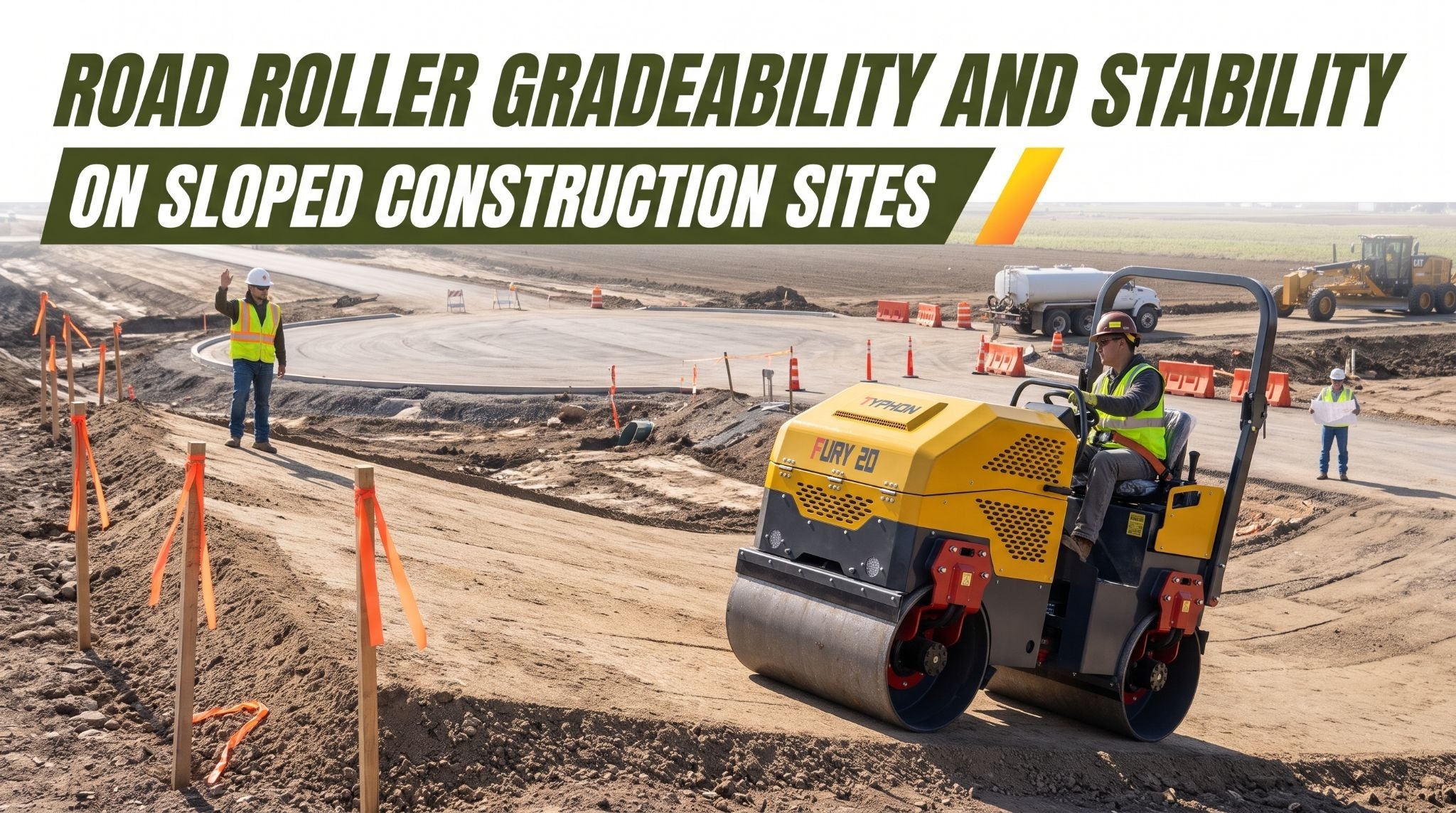
A highway subcontractor is building a new interchange ramp. The crew finishes placing a lift of granular base on the embankment slope and brings in a single-drum vibratory roller to compact it. The operator has run this model on flat subgrade for months. The specification sheet lists a gradeability well above the ramp’s grade, so nobody gives the slope much thought. Halfway up the first pass, a light rain that started at lunch has turned the surface fines slick. The drive tires begin to spin, the drum chatters with vibration still on, and the machine slides sideways a few inches toward the unfinished embankment edge. The operator stops, lowers the throttle, and works the roller back down in a straight line. Nobody is hurt, and the machine stays upright. The near miss had nothing to do with the roller’s capability on paper. It came from wet surface traction, vibration left on during a climb, and a travel line that drifted toward an unsupported edge.
Road rollers compact soil, aggregate, and asphalt on ramps, embankments, shoulders, driveways, and sloped pads. Gradeability and stability determine how safely a roller can work on these surfaces, and both depend on far more than a single published number. Machine weight and balance, drum and drive arrangement, surface traction, steering and braking condition, route planning, and changing weather all decide whether a pass ends with a well-compacted lift or a machine in trouble. This guide explains each factor so your crews can compact sloped areas productively while keeping operators, ground workers, and equipment safe.
Understand Road Roller Gradeability
The published figure reflects test conditions that may look very different from a real jobsite. Gradeability is commonly measured on a firm, dry surface with good traction, with the machine in a defined configuration traveling in a specific direction. Many manufacturers publish separate figures with vibration on and vibration off, and the vibration-off figure is usually higher, since vibration can reduce the drum’s grip on the surface. Some list different ratings for smooth drums and padfoot drums, or for machines with one driven drum versus both driven. Water tank level on asphalt rollers and ballast on pneumatic rollers can also shift the numbers. Ask each manufacturer exactly how its figure was measured, including surface type, machine weight, drum configuration, vibration status, and travel direction.
Gradeability also addresses a different question from stability. Engine horsepower and drive power help determine whether a roller has enough power to climb a slope, while traction affects its ability to maintain grip. However, a machine may climb successfully while being far less stable when it turns, travels across the grade, or stops near an edge. Many manufacturers publish a separate static tipping angle or lateral stability figure alongside maximum permitted operating slopes in the operator’s manual. These operating limits are often much lower than the climbing figure, and when the manual and the brochure disagree, the manual takes priority.
Treat the published gradeability as a measure of the machine’s capability, not a universal operating limit. On a real site, loose material, moisture, surface compaction state, cross-slope, and operator inputs all reduce the margin between safe travel and a slide or rollover. Measure the actual grades on your project with a digital inclinometer, survey data, or site drawings, and measure along the travel line and across it, because cross-slopes are often steeper than they appear. Then compare those measurements with the manufacturer’s operating slope limits for the exact configuration you plan to run, leaving practical margin.
Key takeaway: Gradeability is the climbing capability measured under specified conditions. Confirm how each figure was measured, convert percent and degrees carefully, and follow the operator’s manual slope limits, which are often lower than the published gradeability.
Check Steering and Braking Systems
Steering and braking are the systems that keep a roller under control when gravity is working against it. On a level pad, a slow brake response or a little steering play may go unnoticed. On a slope, the same fault can let the machine roll, drift toward an edge, or fail to hold position. Reliable steering and braking are essential before any roller enters a sloped area.
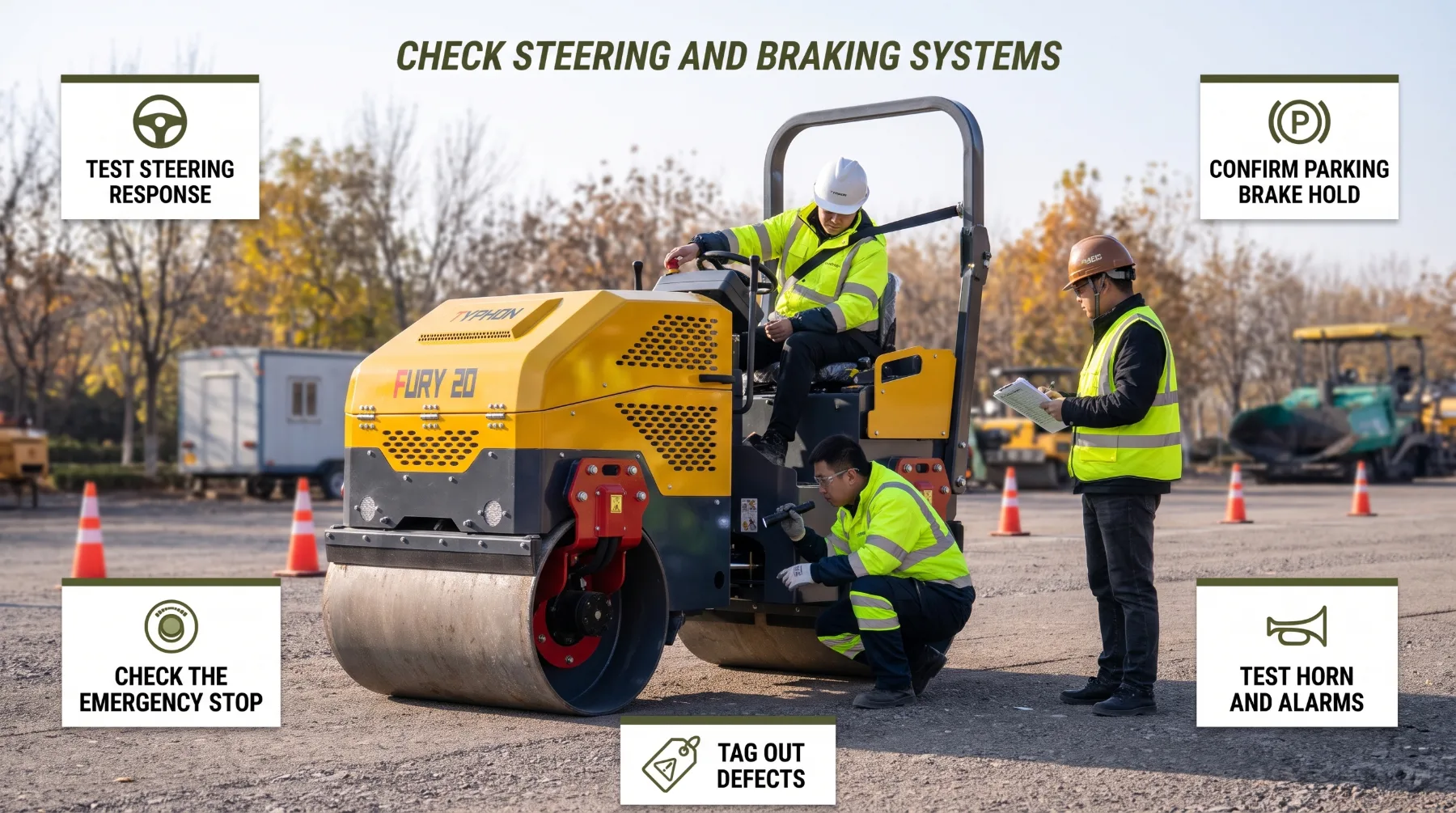
Most modern ride-on rollers use hydrostatic drive, where hydraulic pumps and motors power the drums or wheels. Moving the travel lever toward neutral slows the machine through the hydraulic system, which provides much of the day-to-day braking. These machines also have a parking brake, often spring-applied and hydraulically released, that engages automatically when the machine stops or the engine shuts down. Many include an emergency stop that applies the brakes immediately. Understanding how your machine’s specific system works tells you what normal behavior should feel and look like.
Then test function on level ground before approaching any slope. Travel slowly in a clear area and check that steering responds smoothly through its full range without excessive play, binding, jerking, or unusual noise. Bring the travel lever to neutral and confirm that the roller slows and stops predictably in a straight line. Test the parking brake and emergency stop using the manufacturer’s procedure. Report any abnormal response immediately, including steering that feels heavy or loose, a machine that drifts when the lever is centered, a parking brake that does not hold, delayed stopping, or new noises from drive or brake components. Keep any machine with a steering or braking defect off slopes and out of service until a qualified technician repairs it.
Key takeaway: Inspect steering, brakes, emergency stops, and alarms before every shift, test function on level ground before approaching any slope, report abnormal response immediately, and train operators on the machine’s travel and braking behavior before slope work.
Consider Machine Weight and Center of Gravity
A roller’s stability on a slope depends on where its weight sits and how wide its base is. Heavy weight helps compaction, but weight alone does not make a machine stable. Weight distribution, center of gravity height, drum arrangement, articulation, and equipment configuration all determine how the roller behaves when the ground tilts.
Every machine has a center of gravity, the point where its combined weight acts. On level ground, that point sits comfortably inside the area defined by the drums or tires. As the machine climbs, descends, or crosses a slope, the center of gravity shifts toward the downhill edge of that base. A roller becomes unstable when that point moves outside its base, and a higher center of gravity reaches that point sooner. Cross-slopes are especially demanding because rollers are usually much narrower than they are long, so they tip sideways at a far smaller angle than they would forward or backward.
Drum arrangement shapes how weight reaches the ground. Single-drum soil compactors carry a heavy vibratory drum at the front and drive tires at the rear, splitting weight unevenly between the two ends. Tandem asphalt rollers carry steel drums at both ends, often with both driven, which can improve gradeability on firm surfaces. Pneumatic rollers spread weight across multiple rubber tires and frequently use water or ballast to adjust total weight. Trench and walk-behind rollers are smaller and lighter, and their operator position changes how slope work must be planned. Review how weight is distributed on each model, since a front-heavy machine may behave very differently going uphill versus downhill.
Articulation adds another factor. Most ride-on rollers use articulated steering, with a center joint that lets the front and rear frames pivot relative to each other. When the machine is steered sharply, the drums no longer line up, and the effective width of the stability base shrinks on one side. Turning on a slope with the frame articulated can move the center of gravity much closer to the tipping edge. Some rollers also have an oscillating joint that lets the frames rock to follow uneven ground, which improves contact and traction but can allow more body roll on side slopes.
Equipment configuration changes the numbers as well. Water tanks for drum spray systems add weight that shifts as the level drops and can slosh on grades. Padfoot shell kits, edge cutters, cabs, canopies, and added ballast all change total weight and center of gravity height. A roller fitted with a padfoot kit, a full water tank, and a cab may have different slope limits than the base machine on the brochure. Confirm slope ratings for the exact configuration you plan to operate, and follow the manufacturer’s instructions for slopes. Ride-on rollers are typically fitted with a rollover protective structure, and OSHA’s construction standard at 29 CFR 1926.602(a)(2) requires seat belts on covered earthmoving and compacting equipment. Operators should always wear the seat belt, and the rollover protective structure must never be drilled, welded, cut, or modified.
Key takeaway: Slope stability depends on weight distribution, center of gravity height, drum arrangement, articulation, and equipment configuration. Confirm slope limits for the exact machine setup, avoid articulated turns on slopes, and always wear the seat belt.
Evaluate Surface Traction
A roller can only climb, descend, and stop on a slope as well as the surface allows. Traction is the grip between the drums or tires and the ground, and it changes dramatically from one material to the next. On a slope, the margin for lost traction gets smaller because gravity is already pulling the machine downhill. When grip fails, the roller can slide, skid, or lose steering control, often toward the most hazardous edge.
Each material behaves differently. Loose, uncompacted soil and freshly placed fill offer limited support. Drums can sink or push material ahead, and tires can spin. Wet clay is one of the most hazardous surfaces on any slope. Even a thin film of moisture on clay can make it slick enough for a heavy roller to slide with the brakes applied, and clay also builds up on drums and tires, reducing grip further. Gravel and crushed aggregate usually provide better traction once compacted, but loose surface stones can roll under the drum, and fines on the surface can become slippery when wet. Asphalt brings its own challenges. Hot mix can shove or displace when a roller brakes, accelerates, or turns sharply on a grade, and cooling asphalt sprayed with water or release agents can be slicker than expected.
Vibration affects traction on every material. A vibrating drum alternately presses and lifts off the surface, reducing its effective grip. Many manufacturers recommend turning vibration off when climbing or descending steep grades, when stopping, and before changing direction. Vibration can also loosen surface material on a slope and cause it to migrate downhill. Check the operator’s manual for the specific vibration guidance on slopes for each model.
Assess the surface before every slope passes. Walk the slope and look for loose material, soft spots, ruts, wet areas, seepage, and sticky clay. Check drums and tires for material buildup, and confirm that scrapers are adjusted and working. Look at the edges of the slope for cracks, settlement, or signs of instability. Avoid slopes that exceed the machine’s approved limits for the current surface, and remember that traction on the same slope can change from morning to afternoon as moisture and compaction levels shift.
Key takeaway: Traction varies widely across loose soil, wet clay, gravel, aggregate, and asphalt. Assess the surface before each slope passes, manage vibration as the manufacturer directs, and avoid slopes that exceed the machine’s approved limits for current conditions.
Plan Compaction Routes
On a sloped site, the route a roller follows matters as much as the machine itself. A well-planned route keeps the roller within its operating limits, minimizes turning on grades, and keeps people and other equipment out of harm’s way. A poorly planned route forces the operator to improvise on the slope, which is when most loss-of-control incidents happen.
Rollers should generally travel straight up and down slopes rather than across them. Crossing a slope tilts the machine sideways toward its narrowest and least stable axis, and loose material on the downhill side can give way under the drum. Follow the manufacturer’s recommended travel direction and orientation for slope work. When the project geometry requires compacting a cross-slope, confirm that the slope stays within the manual’s lateral limits and consider whether a smaller roller or another compaction method suits the area better.
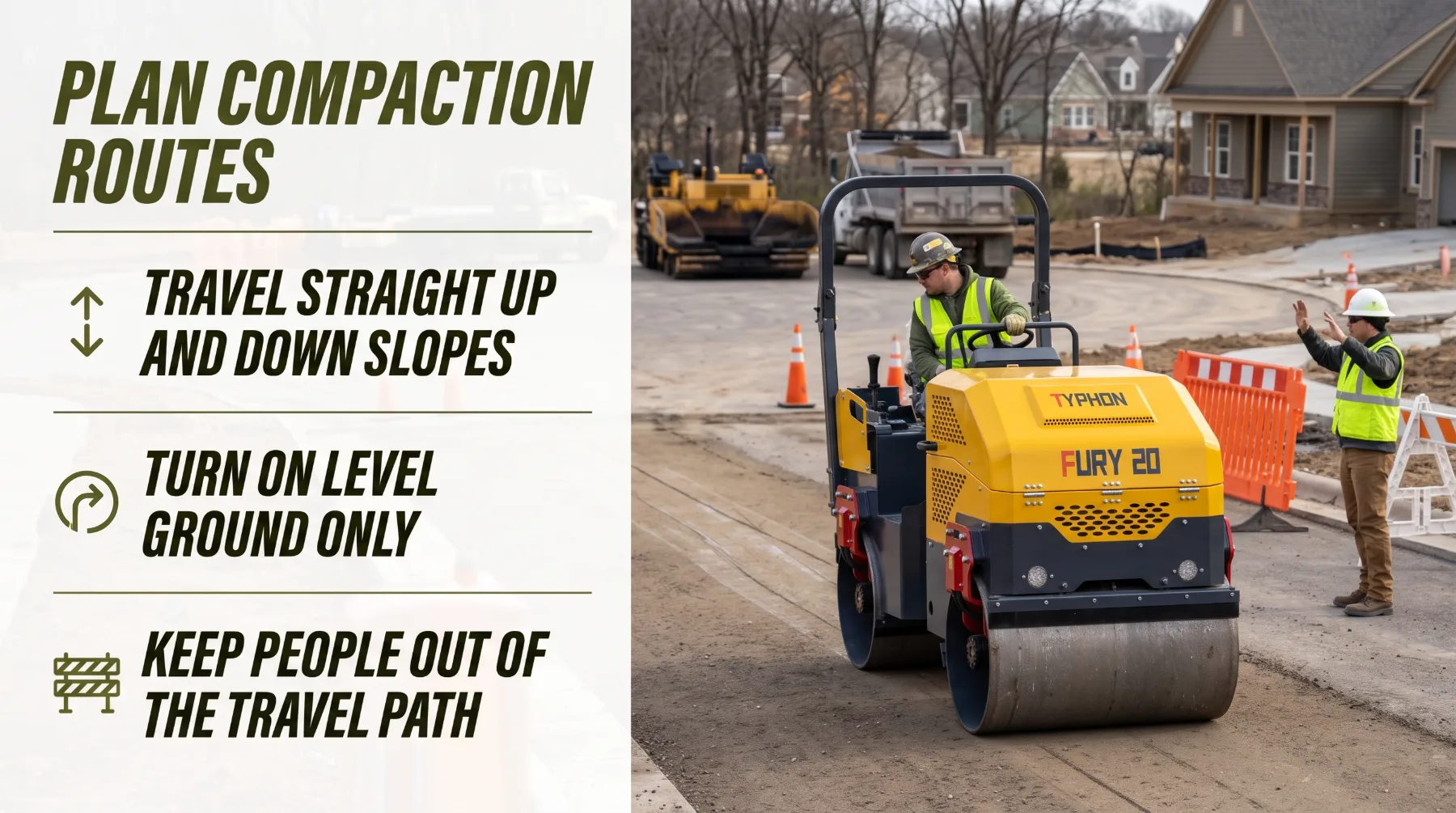
Minimize turning on slopes. Plan the route so the roller changes direction on flat, firm ground at the top or bottom of the slope wherever possible. Bring the machine to a complete stop and switch vibration off before reversing direction. Where a turnaround area does not exist, build one into the site plan. Plan for edges and drop-offs as well. Embankment edges, fill slopes, trench lines, and unsupported shoulders can collapse under the weight and vibration of a roller. Establish a setback from unsupported edges based on the engineer’s guidance and site conditions, and mark edges clearly with stakes, paint, or barriers so the operator can see them from the seat.
Key takeaway: Travel straight up and down slopes, turn on level ground at the top or bottom, maintain setbacks from unsupported edges, separate people and equipment from the roller’s path, and brief every operator on the documented route plan before work begins.
Monitor Weather and Ground Conditions
Rain is the most obvious hazard. Even a light shower can turn clay and fine-grained soils slick, wash fines to the surface of aggregate, and soften fill along embankment edges. Water running down a slope can erode the surface and undercut edges. Heavy rain can saturate fill and reduce its strength. Morning dew and runoff from drum spray systems can create similar problems on a smaller scale. Watch the forecast and plan slope work for the driest part of the day whenever possible.
Temperature changes affect traction as well. Frost and freeze-thaw cycles can leave a thin, slick layer on otherwise firm ground and loosen surface material as it thaws. Hot, dry conditions can turn compacted surfaces dusty and loose, while asphalt that cools faster than expected on a windy day changes how the mat responds to rolling. Ground conditions also change as work progresses. New lifts of loose material offer less traction than the compacted layer beneath them. Material can build up on drums and tires, ruts and soft spots can appear, and haul traffic can loosen the surface. Seepage from the slope face, cracks along the top of an embankment, and bulging near the toe all signal possible instability that needs immediate attention.
Reassess the work area after rain, at the start of each shift, and whenever the operator notices a change in how the roller handles. Signs that the surface is becoming unsuitable include drums or tires that slip or spin, a machine that slides when stopped, steering that feels less responsive, and edges that appear to crack or settle. Encourage operators to report these signs immediately, and make sure they know they have the authority to stop. When the surface becomes unsuitable, bring the roller to a controlled stop, switch off vibration, and travel straight down the slope to level ground at slow speed. Park on firm, level ground with the parking brake set, and do not resume slope work until a competent person confirms that conditions fall within the machine’s approved limits.
Key takeaway: Weather and ground conditions change traction and stability throughout the day. Reassess the slope after rain, at each shift start, and whenever handling changes, and stop work as soon as the surface becomes unsuitable.
Conclusion
Road roller gradeability and stability depend on machine design, operating conditions, and ground surface. Gradeability indicates climbing capability under specified test conditions, while the operator’s manual provides the applicable slope limits. Weight distribution, center of gravity, drum arrangement, articulation, and machine configuration all influence stability on inclined ground. Traction also varies across soil, clay, gravel, aggregate, and asphalt, with vibration potentially reducing grip further. Reliable steering and braking, planned compaction routes, and continuous monitoring of ground and weather conditions help maintain control. Assess actual grades and cross-slopes against the manufacturer’s operating limits for the exact roller configuration. Include steering, braking, and warning-system checks in pre-shift inspections, and establish a route plan covering travel direction, turnaround areas, edge setbacks, and exclusion zones. Brief operators on these procedures and give them clear authority to stop when conditions become unsafe. Careful planning and operation help achieve consistent compaction while protecting equipment and crews.
Frequently Asked Questions
What does road roller gradeability mean?
It describes the slope a roller is designed to climb under specified conditions, usually expressed as a percentage or in degrees. The figure is typically measured on a firm, dry surface in a defined machine configuration, often with vibration off. It is not a universal operating limit, so always follow the slope limits in the operator’s manual for the exact configuration you run.
Does machine weight determine slope stability?
No. Weight distribution, center of gravity height, drum arrangement, articulation, equipment configuration, traction, and surface conditions all affect stability. A heavy roller with a high center of gravity, or an articulated turn on a cross-slope, can become unstable quickly regardless of total weight.
Can a roller work on wet slopes?
Only if conditions remain within the manufacturer’s approved operating limits. Wet clay, fines on aggregate, and damp asphalt can reduce traction sharply, even on moderate grades. Reassess the slope after rain and stop work if the drums or tires slip or the machine slides.
What should operators check before working on a slope?
Review the surface, measured grade and cross-slope, edge conditions, steering and braking function, emergency stop, alarms, seat belt, the machine’s slope limits, and the planned travel route. Confirm that people and other equipment are clear of the roller’s path and that a spotter is in place where visibility is limited.