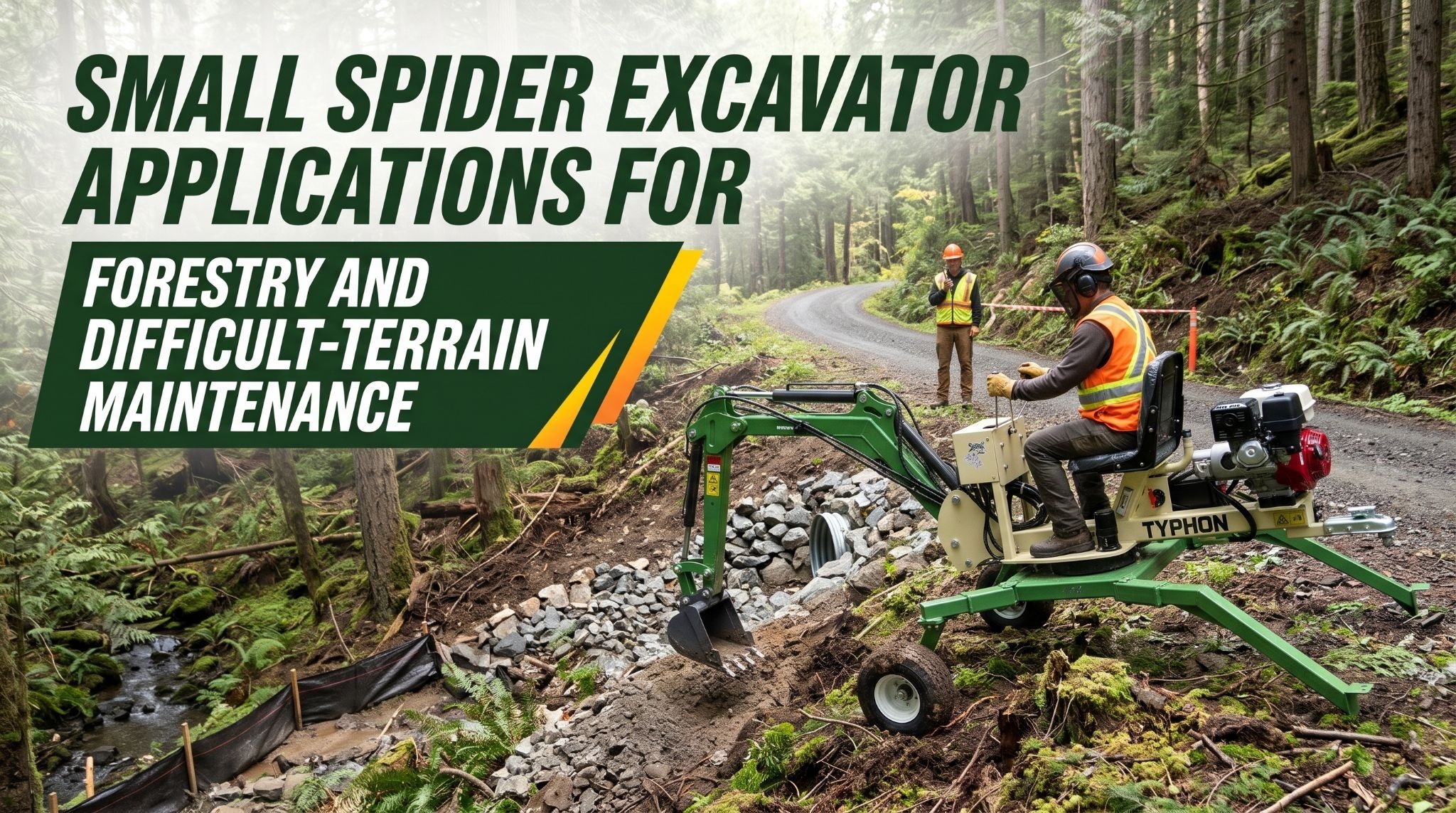
A forestry crew needs to reopen a blocked culvert on a steep haul road three miles from the nearest paved access. A land manager has to clear sediment from a drainage channel that cuts through a wooded hillside. A utility contractor must repair erosion beneath a hiking trail bridge where no conventional excavator can safely stand. Each job is small in scale but difficult in setting. Narrow tracks, soft banks, standing trees, and uneven ground rule out most of the equipment a contractor would normally bring.
A small spider excavator, also called a walking excavator, is built for this kind of work. It uses independently positioned legs, often fitted with wheels or pads, to support and level the machine. In suitable conditions, that design lets it work on uneven ground, straddle obstacles, and reach areas where tracked machines struggle to set up. For forestry and difficult-terrain maintenance, it can make specialized excavation possible with less ground disturbance and fewer access improvements.
Suitability still depends on the specific machine, its permitted operating limits, attachment compatibility, and the conditions on site. A spider excavator is a capable tool, not a guarantee of safe operation on every slope or surface. Careful planning, trained operators, and respect for manufacturer limits determine whether it delivers on its potential.
Accessing Remote and Restricted Areas
Forestry and backcountry work often begins with one question: can the machine get there? Narrow trails, gated logging roads, soft landings, tree roots, rock outcrops, and limited turning space all restrict access long before digging begins. A small spider excavator can reach some of these areas without requiring a large excavator or extensive road improvements, but only when its dimensions and weight fit the route.
Many spider excavators can fold or retract their legs into a narrower travel configuration, then extend them at the work site for a wider, more stable stance. Check the manufacturer’s published dimensions for both configurations, including transport width with legs retracted, working width with legs extended, overall height with the boom folded, and the minimum clearance required between trees or rock features. Compare those figures with the narrowest point on the route, not just the trailhead. A machine that clears the gate but can’t pass between two standing trees halfway along the trail won’t reach the job.
Operating weight affects transport, but it also determines how much pressure the machine places on the ground. Forest soils, saturated landings, peat, and recently disturbed fill may not support concentrated loads. Spider excavators distribute weight through their legs and pads, and that load can be high at each contact point. Assess ground-bearing conditions along the route and at the work area, and look for soft spots, buried logs, rotted stumps, voids beneath root mats, and areas where water collects. Where needed, use approved ground mats or timber pads to spread loads, following the manufacturer’s guidance.
Walk the full route before the machine arrives. Note gates, bridges, and culverts along with their load ratings, overhanging branches and leaning trees, steep pitches and side slopes, stream crossings, and places where the machine can turn, park, or be recovered if needed. Check land-use permissions and any seasonal restrictions as well, since some forestry areas limit machine access during wet seasons, wildlife nesting periods, or high fire danger.
Key takeaway: Confirm the spider excavator’s transport and working dimensions, operating weight, and ground-bearing needs against the full access route, and walk that route in advance to identify bridges, culverts, soft ground, and turning points.
Transport, Maintenance, and Safe Operation
Difficult-terrain work increases the consequences of mechanical failure and operator error. A hose failure on a slope, a damaged leg component, or a machine stuck far from help can turn a routine job into an emergency. Build every operation around these five practices.
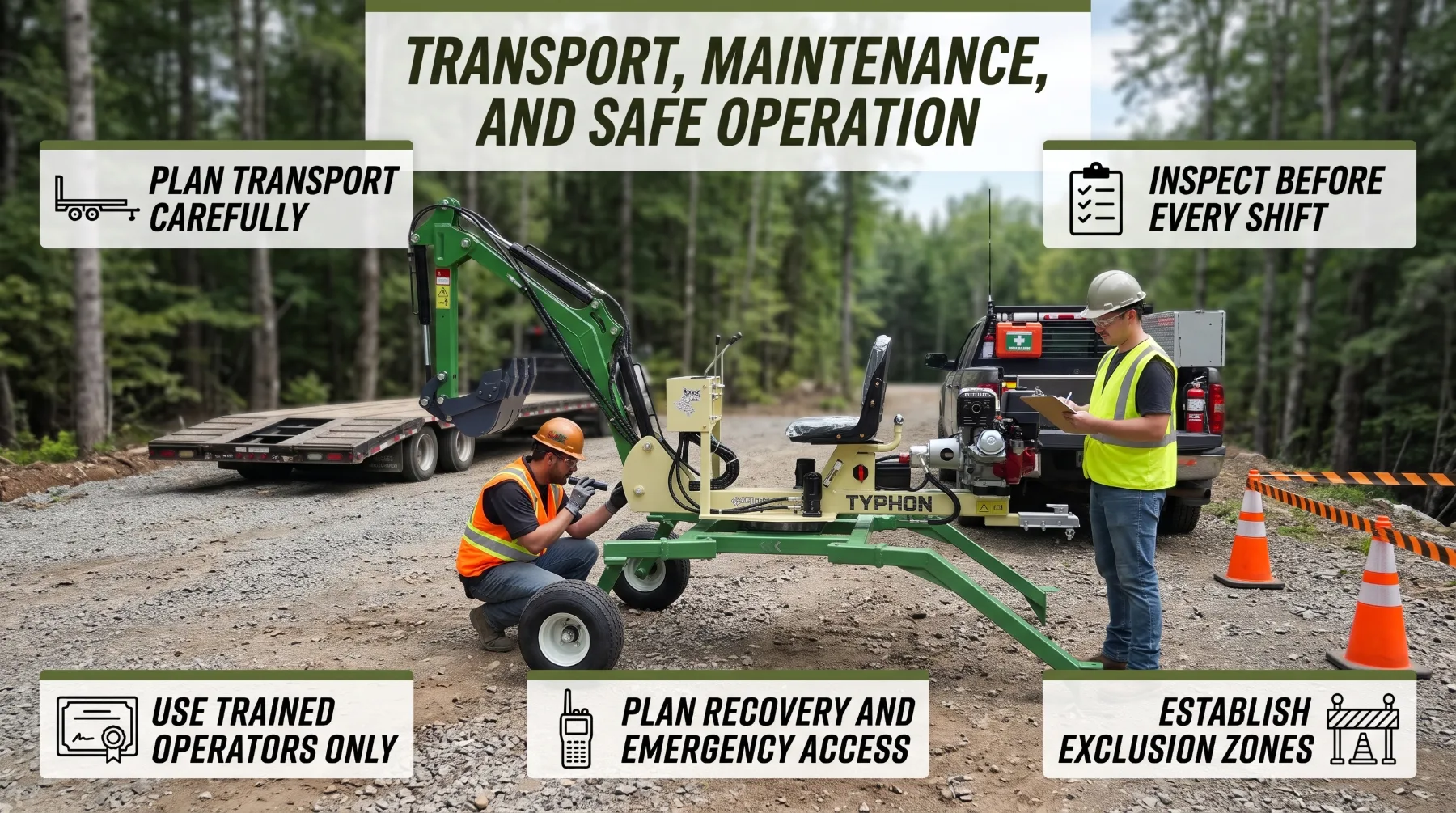
- Plan Transport Carefully: Confirm transport weight, trailer and tow vehicle ratings, loading procedures, and securement points before moving the machine.
- Inspect Before Every Shift: Check legs, pads or wheels, tracks where fitted, hydraulic hoses, cylinders, pins, controls, and safety devices.
- Use Trained Operators Only: Ensure operators are trained on the specific spider excavator, including leg positioning and stability limits.
- Establish Exclusion Zones: Keep people clear of the boom swing, attachment reach, and downslope areas where material or the machine could move.
- Plan Recovery and Emergency Access: Identify how the machine and operator would be reached, recovered, or evacuated if something goes wrong.
Spider excavators often need specific loading procedures because of their leg configuration. Follow the manufacturer’s instructions for folding legs, loading, and securing the machine. Use approved tie-down points and rated securement equipment. Some models can be lifted for placement on very difficult sites, but only using approved lifting points, rigging, and qualified lift planning.
Daily inspections should cover leg structures, pivots, pins, and bushings for wear or cracks, pads and wheels for damage and secure mounting, hydraulic hoses and fittings for abrasion and leaks, cylinders and rods for scoring or bending, and controls, emergency stops, and warning devices. Branches and rocks can damage hoses that would rarely be at risk on a normal site. Address leaks immediately, especially near watercourses, and follow the manufacturer’s service intervals while keeping maintenance records.
Operating a spider excavator requires skills beyond conventional excavator experience. Leg positioning, leveling, and stability management take training and practice. Operators should understand the machine’s limits, recognize warning signs of instability, and know how to stop safely. Mark exclusion zones around the work area, including downslope zones where rocks, logs, or spoils could roll, and agree on hand signals or radio communication with ground crew. Never allow anyone to stand beneath the boom or below the machine on a slope.
Remote sites make help slower to arrive. Before work begins, confirm cell or radio coverage, share the work plan and location with someone off site, and avoid lone working where possible. Identify how a stuck or disabled machine could be recovered, and keep first aid equipment and emergency contact information on hand.
Key takeaway: Plan transport carefully, inspect legs, hoses, cylinders, and control every shift, use operators trained on the specific machine, enforce exclusion zones, and prepare recovery and emergency access before work begins.
Drainage and Erosion Maintenance
Water is one of the biggest threats to forest roads, trails, and hillsides. Blocked ditches and culverts send runoff across road surfaces, cut gullies, and carry sediment into streams. A small spider excavator can support drainage and erosion work in places where access is too difficult for larger equipment.
Over time, drainage channels fill with sediment, leaves, branches, and debris. A suitable bucket can remove accumulated material, restore the channel’s capacity, and clear culvert inlets and outlets. Work from a stable position, keep the bucket clear of culvert pipes and headwalls, and avoid deepening the channel beyond its intended grade. Place removed material where it won’t wash back into the channel or a watercourse. Spreading it thinly on stable ground, hauling it out, or placing it behind sediment controls are common approaches depending on site requirements.
Roadside ditches and cross drains keep water moving away from forest roads. A spider excavator can reshape ditch profiles, clean cross drains, and restore outlets that have become blocked or undercut. Maintain the designed slope so water flows at a controlled rate rather than scouring the ditch. Depending on the site plan, spider excavators may also assist with shaping and stabilizing small gullies, placing rock armoring at culvert outlets or ditch turns, building or repairing water bars and grade dips on trails and roads, and preparing slopes for vegetation or erosion-control matting. Each task should follow the approved design or land manager’s instructions, since erosion work done without a plan can move the problem downstream rather than solve it.
Drainage work often happens close to sensitive areas. Plan every task to avoid destabilizing banks, damaging watercourses, or disturbing protected habitats. Before starting, confirm any permits or approvals required for work in or near streams and wetlands, install silt fencing and sediment traps as required, and keep fuel, hydraulic oil, and spill kits ready. Refuel away from water, minimize in-water work, and avoid sensitive seasons where restrictions apply. Use biodegradable hydraulic fluid where the manufacturer approves it and the site requires it, since a hose failure near a stream can cause serious environmental damage.
Key takeaway: Spider excavators can clear channels, maintain ditches, and support erosion control in hard-to-reach areas, but work must follow approved designs, protect banks and watercourses, and include sediment and spill controls.
Slope and Uneven-Terrain Work
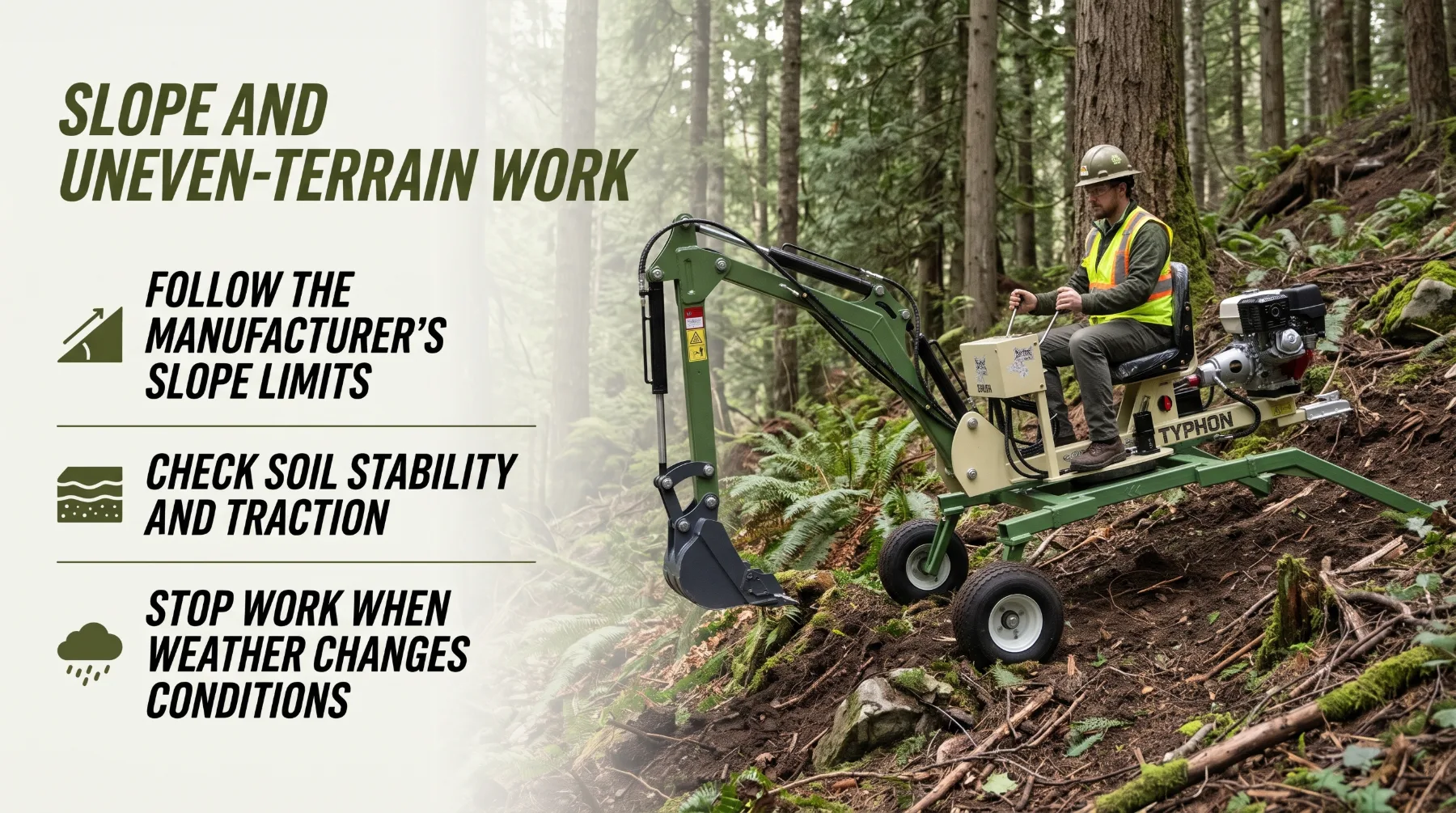
The design that makes spider excavators distinctive is their ability to adjust leg positions independently. In suitable conditions, the operator can level the upper structure on uneven ground, position legs at different heights, and set up on terrain that would leave a conventional tracked machine tilted or unstable. That capability is valuable, but it has firm limits.
No machine should be assumed safe on every slope. Each spider excavator has manufacturer-specified limits for slope angle, leg position, boom reach, swing, and lifting capacity. Those limits may change depending on whether the machine is traveling, digging, or lifting, and on how far the legs are extended. Read the operator’s manual and stability information for the exact model. Never exceed published limits because the machine “feels” stable. Stability can change suddenly as the boom swings, a load lifts, or the ground beneath a leg gives way.
Slope angle is only part of the picture. The ground itself must support the machine. Saturated clay, loose sand, and organic forest soil can shift or compress under load. Root mats and stumps may feel firm but conceal voids or rot beneath. Loose rock and scree can cause pads to slip or roll material downslope, and banks, ditch edges, and cut slopes may collapse under concentrated weight. Test suspicious ground before committing a leg to it, and where possible, place pads on firm, undisturbed soil rather than fresh spoil or fill.
Wet leaves, moss, mud, frost, and exposed roots can reduce traction dramatically. A pad or wheel that slides even slightly on a slope can change the machine’s balance. Keep pads clean, use any approved claws, spikes, or traction aids specified by the manufacturer, and reposition the machine rather than working from a questionable footing. Weather changes difficult terrain quickly, so check the forecast before work begins and reassess conditions throughout the shift. Stop work when conditions move outside safe limits, including heavy rain, saturated ground, high winds in wooded areas, and poor visibility from fog or low light.
Key takeaway: Spider excavators can work on some challenging terrain, but operators must follow the manufacturer’s slope and stability limits, assess soil stability and traction before positioning each leg, and stop work when weather changes ground conditions.
Vegetation and Forestry Site Preparation
Forestry operations regularly need small-scale earthwork in difficult locations. A spider excavator can assist with selected site preparation tasks when it is properly equipped and the hazards of a wooded environment are fully assessed.
Fallen logs, rocks, root balls, and debris often block trails, access routes, and drainage paths. With a suitable bucket or approved grapple, a spider excavator can move manageable obstructions and clear working space. Stay within the machine’s rated lifting limits, which may vary with boom reach and leg position, and never attempt to pull or push standing trees beyond what the machine and attachment are approved to handle. Spider excavators may also help shape trail entrances, small landings, turnouts, and approaches to crossings, and can dig for approved site improvements such as signposts, small footings, fencing, or planting holes. Their ability to work on uneven ground can reduce the amount of grading needed before work begins. Keep disturbance to the minimum the job requires, since excess grading in forest soils can increase erosion and damage root systems of trees that should remain.
Wooded sites carry hazards above the operator as well as below. Before starting, inspect the area for dead, damaged, or leaning trees that could fall when disturbed, hanging branches lodged in the canopy, and trees with root systems that may be undermined by the work. Fell or remove hazardous trees before machine work begins where required, using qualified personnel. Keep the boom and attachment well clear of overhead power lines and communication cables, and remember that vibration and root disturbance can destabilize nearby trees during digging.
Remote doesn’t mean free of underground services. Forest land may contain buried pipelines, power or fiber cables, water lines, old culverts, and survey markers. Contact the relevant utility locating service and the landowner before digging, and review any available site records. During dry periods, hot exhaust components and dry vegetation can be a dangerous combination. Clear leaves and debris from the engine compartment regularly, carry a suitable fire extinguisher, and follow local fire-season restrictions.
Key takeaway: Spider excavators can clear obstructions, shape access points, and dig for approved improvements, but operators must assess overhead hazards, locate buried services, minimize soil disturbance, and manage fire risk in dry conditions.
Attachment Selection and Machine Compatibility
Attachments expand what a spider excavator can do, but they also change its weight distribution, hydraulic demands, and safe operating limits. Choosing approved, compatible tools protects both the operator and the machine.
Depending on the model and its approvals, spider excavators may use digging buckets for trenching and channel clearing, ditch cleaning buckets for wide shallow drainage work, tilting buckets or tiltrotators for shaping slopes, grapples for logs and debris, augers for post holes and planting, breakers for rock removal where approved, and vegetation tools such as mulchers or brush cutters only when specifically approved for the machine.
Confirm that each attachment matches the machine’s coupler or mounting system. Quick couplers save time on remote sites, but they must be correctly engaged and checked before every use. Powered attachments need specific hydraulic flow, pressure, and connection types, so compare each tool’s requirements with the machine’s auxiliary circuit ratings. Too little flow can make the tool ineffective, while too much can overheat components or cause damage. Check whether the attachment needs a case drain or separate return line, and route hoses to avoid contact with branches and moving parts.
Attachment weight reduces the load the machine can safely handle, and heavy tools at full reach place significant leverage on the machine. Consult the load charts for the exact configuration, leg position, and boom reach. A grapple or mulcher that works safely close to the machine may exceed limits when extended downslope. Mulchers, brush cutters, and similar tools throw debris and draw heavy hydraulic power, so use them only if both the excavator and attachment are approved for the application. Confirm operator protection requirements such as impact-resistant glazing or guarding, and maintain wide exclusion zones while they run.
Key takeaway: Use only attachments approved for the specific spider excavator, confirm mounting and hydraulic compatibility, consult load charts for each configuration, and verify operator protection before running specialized vegetation tools.
Conclusion
A small spider excavator can support forestry and difficult-terrain maintenance where conventional equipment struggles to access or operate. Its dimensions, operating weight, and ground-bearing requirements must match the full access route and working conditions. Adjustable legs help the machine position itself on uneven ground, but operation must remain within the manufacturer’s slope and stability limits, with sufficient ground support. Suitable applications include clearing drainage channels, maintaining ditches, supporting erosion control, and preparing forestry sites under approved plans that protect nearby watercourses. Approved attachments, correct load chart use, and regular inspections help maintain safe and reliable performance. Each project should begin with an assessment of the access route, slope, and soil conditions at every work position. Confirm required permits for work near water or protected areas, select attachments approved for the machine, and verify that operators have machine-specific training. Establish exclusion zones, clear communication procedures, and a recovery plan with suitable access before positioning the excavator. Careful preparation and operation within manufacturer limits help crews work efficiently while protecting the machine, surrounding terrain, and environment.
Frequently Asked Questions
What forestry tasks can a small spider excavator support?
Depending on its configuration and approved attachments, a spider excavator may assist with drainage channel and culvert clearing, ditch maintenance, erosion control, access preparation, obstruction removal, and digging for approved site improvements. Each task must stay within the machine’s rated limits and follow the site’s work plan.
Can it work on any steep slope?
No. Safe operation depends on the model’s published slope and stability limits, leg positioning, ground stability, surface traction, and weather conditions. Operators must assess each position before setup and stop work when conditions move outside safe limits.
Which attachments can be used?
Use only attachments approved for the specific machine, including those that meet its mounting, hydraulic, and rated load requirements. Specialized vegetation tools such as mulchers should be used only when both the excavator and attachment are approved for the application and operator protection requirements are met.
What should operators check before difficult-terrain work?
Assess slope conditions, access routes, ground stability, overhead hazards, buried services, and weather. Confirm attachment compatibility and the manufacturer’s operating limits, complete a full pre-shift inspection, and establish exclusion zones, communication, and recovery plans.