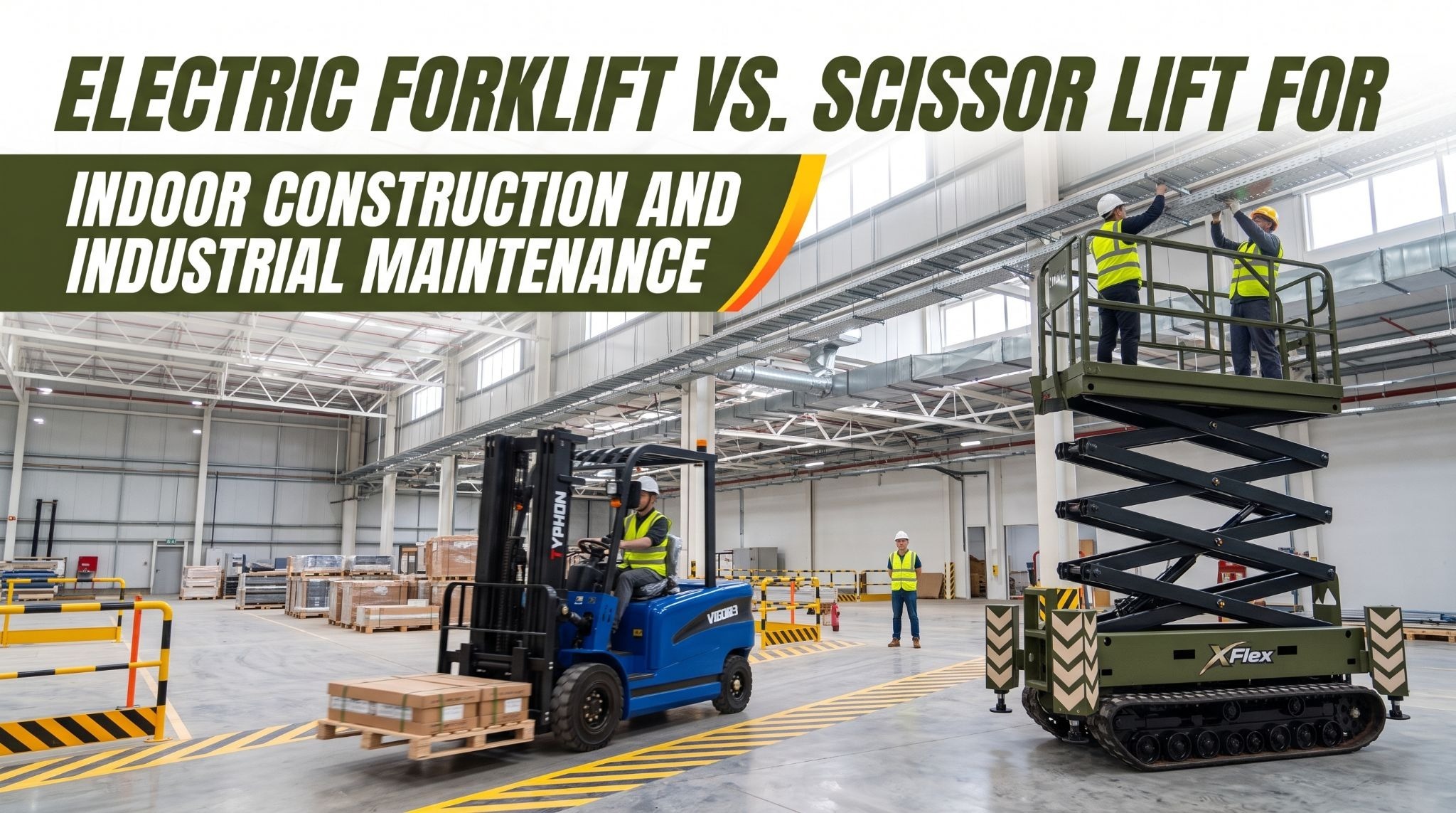
A facility renovation often brings two jobs together in the same space. Pallets of ductwork, cable trays, and fixtures need to move from the dock to the work area. Electricians and mechanical crews then need to reach the ceiling to install them. Both jobs involve lifting, and both often fall to battery-powered machines working indoors. That overlap leads some teams to treat electric forklifts and scissor lifts as interchangeable, which creates real safety and productivity problems.
Electric forklifts and scissor lifts both play important roles in indoor construction and industrial maintenance, but they are engineered for different purposes. An electric forklift lifts, carries, and places materials. A scissor lift raises people, their tools, and permitted materials to an elevated work position on a guarded platform. The specifications, capacities, and safety systems of each machine reflect those different jobs. A forklift’s rated capacity describes a load on the forks. A scissor lift’s rated capacity describes everything on the platform, including the workers.
Understanding the primary purpose of each machine is essential because lifting materials and raising personnel require different equipment and safety considerations. Indoor maneuverability, floor conditions, working height, and load capacity all influence equipment suitability, while battery performance affects daily operating time and productivity. Facility managers, contractors, and maintenance supervisors can evaluate these factors to select the appropriate equipment for maintenance projects and assign tasks safely and efficiently.
Main Purpose and Working Function
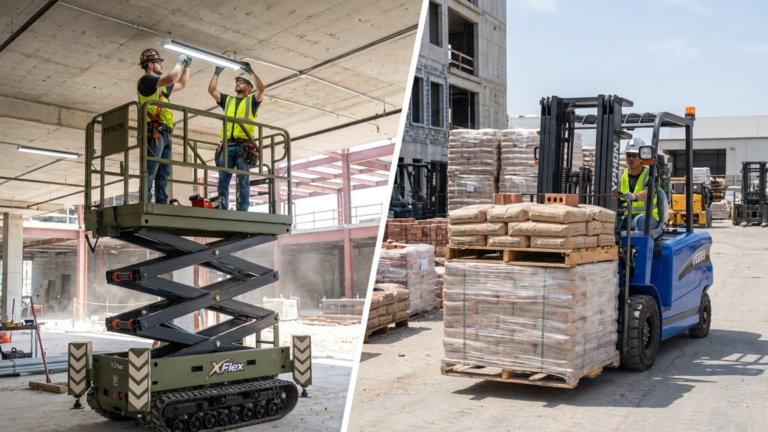
An electric forklift is a material handling machine. Its mast raises and lowers the forks, and its counterweight balances the load carried in front of the truck. That design lets operators pick up pallets, supplies, components, and packaged goods, move them through aisles, and place them on racks, trucks, or staging areas. Electric forklifts are standard equipment in warehouses, manufacturing plants, distribution centers, and industrial facilities where materials move constantly between receiving, storage, and production.
A scissor lift is a mobile elevating work platform. Its crisscrossing support arms extend vertically to raise a guarded platform. That platform carries personnel, their tools, and approved materials to a work position. Scissor lifts are common for overhead installation, ceiling work, lighting replacement, sprinkler and HVAC maintenance, electrical work, inspections, and painting. Their large, stable platforms give workers room to move and position tools at height.
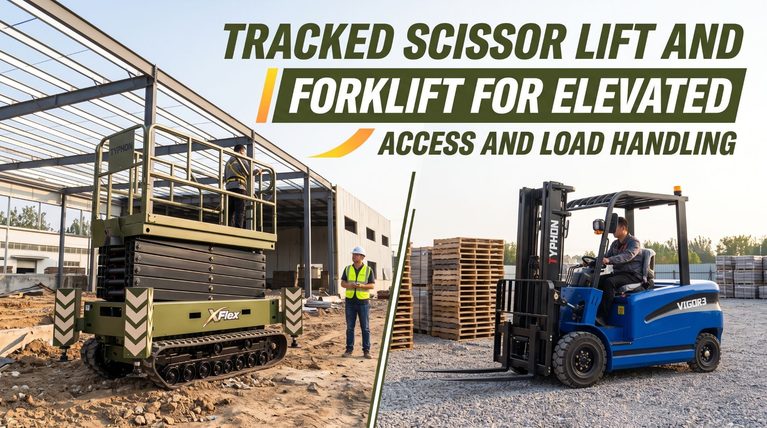
The two machines can appear on the same project, but they do not perform the same function. A forklift moves goods from one place to another. A scissor lift positions people so they can work safely where a ladder would be impractical or unsafe. A forklift can raise a pallet of light fixtures to a mezzanine, but it cannot provide a safe workstation for the electrician installing them. A scissor lift can carry that electrician and a few fixtures to the ceiling, but it is not built to unload a truck.
Understanding that distinction is the foundation for every other decision in this guide. Once you know whether a task involves moving material or positioning workers, the choice of machine becomes much clearer.
Key takeaway: Electric forklifts are designed to lift and transport materials, while scissor lifts are designed to raise personnel and their tools to elevated work positions, so the core function of the task should determine which machine you use.
Selecting Equipment for Maintenance Projects
The right machine depends on what the task requires, not on which equipment happens to be available. Choose an electric forklift when the main requirement is moving or stacking materials, and select a scissor lift when workers need a properly designed platform to reach an elevated work area. Many projects require both, such as a facility renovation where pallets are delivered and staged before crews install fixtures overhead. Evaluate these five factors before assigning equipment.
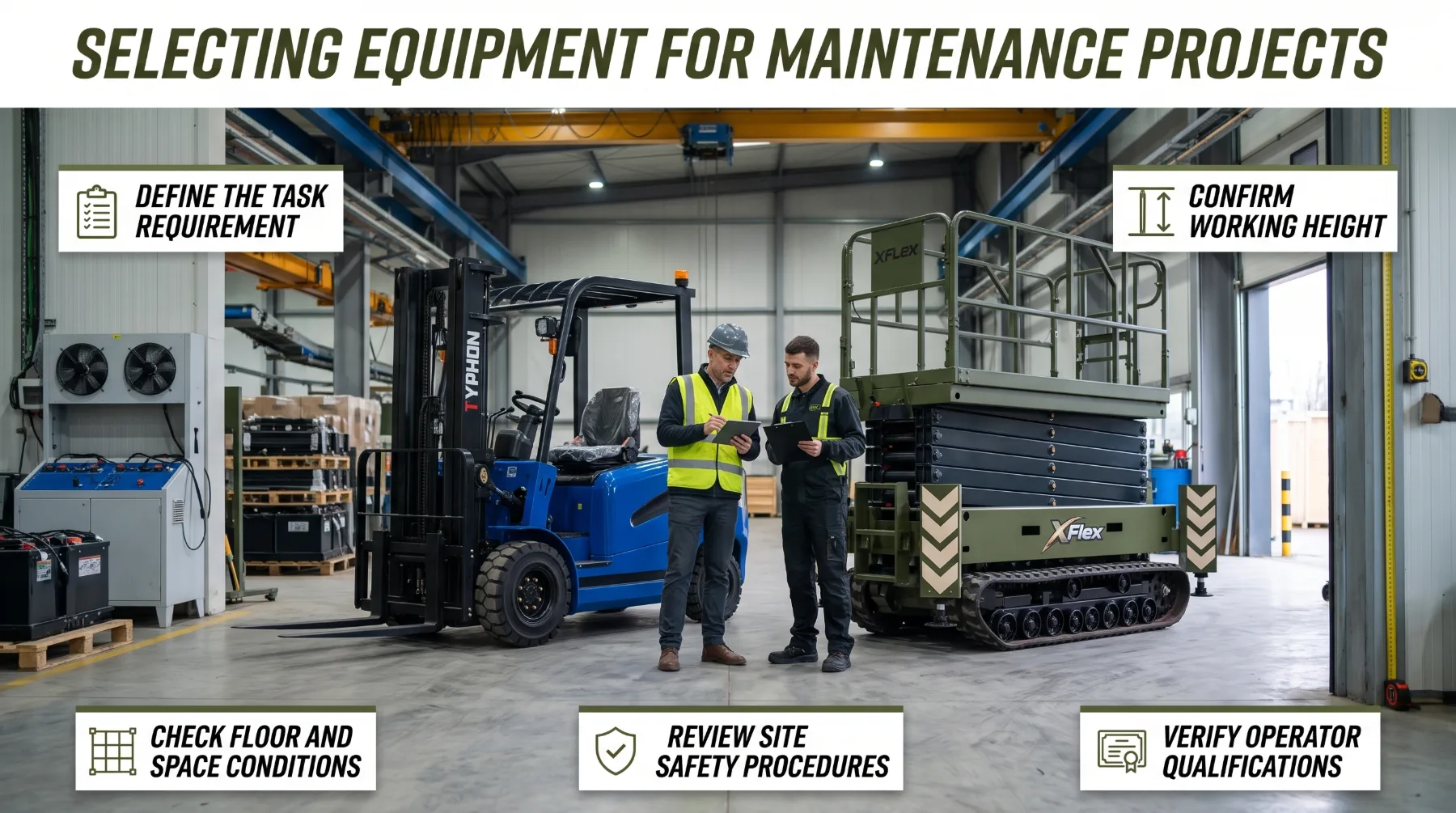
- Task Requirement: Determine whether the work involves moving materials or positioning personnel, and assign a forklift or scissor lift accordingly.
- Working Height: Confirm the required lift height for materials or the platform and working height needed to reach the task safely.
- Floor and Space Conditions: Check floor load limits, surface condition, doorways, aisles, ramps, and overhead obstructions along the route and at the work area.
- Operator Qualifications: Make sure each operator holds the training and authorization required for the specific forklift or aerial work platform.
- Site Safety Procedures: Review fall protection, exclusion zones, charging arrangements, and emergency lowering and rescue plans before work begins.
Key takeaway: Select equipment by matching the task requirement, working height, floor and space conditions, operator qualifications, and site safety procedures, and plan for both machines when a project involves material delivery and overhead work.
Indoor Maneuverability and Floor Conditions
Electric forklifts suit indoor environments because they produce no exhaust emissions at the point of use. They also run quietly compared with internal combustion trucks, which helps in occupied facilities, food and pharmaceutical operations, and production areas where air quality matters. Compact designs and tight turning let them work through warehouse aisles, around production lines, and across loading docks.
Electric scissor lifts are equally common indoors. Slab scissor lifts with non-marking tires are designed for smooth concrete floors, and narrow models can pass through standard doorways and travel between rows of equipment. That makes them practical for ceiling work above machinery, production lines, retail fixtures, and office spaces under renovation.
Both machines depend on suitable floor conditions. Check floor load limits, especially on mezzanines, raised floors, suspended slabs, and older buildings, because the machine’s weight concentrates through its wheels or tires. Look for floor drains, trench covers, expansion joints, cracks, and debris along the travel route. A scissor lift must operate on a firm, level surface, and most models restrict or prevent driving while elevated beyond certain limits on uneven ground.
Clearance matters in every direction. Measure doorway widths and heights, aisle widths, and ramp gradients before bringing a machine onto a site. For scissor lifts, survey overhead obstructions such as beams, ductwork, sprinkler heads, light fixtures, and overhead cranes, since contact can trap a worker against a fixed structure. Follow site-specific restrictions on traffic routes, pedestrian zones, and working hours.
Key takeaway: Electric forklifts and scissor lifts both work well indoors, but you should confirm floor load limits, surface condition, doorway and aisle dimensions, ramps, and overhead obstructions before operating either machine.
Working Height and Load Capacity
Forklift lifting height and capacity depend on the mast, load center, attachment, and overall configuration. The data plate states the rated capacity at a specified load center and lift height. Capacity typically decreases as the load center extends outward or as the load is raised higher. Adding an attachment such as a sideshifter or clamp can reduce capacity further, and the data plate should reflect the complete configuration.
Scissor lifts use a different set of measurements. Platform height is the distance from the floor to the platform deck when fully raised. Working height is a reference figure that adds an estimated worker reach above the platform. Rated platform capacity is the maximum combined weight of personnel, tools, and materials the platform can carry. Some models also limit the number of occupants or reduce capacity when an extension deck is in use, and outdoor-rated models may carry different limits for wind exposure.
These figures are not interchangeable. A forklift that lifts a heavy pallet to a high rack is not suitable for raising workers to that height. A scissor lift that reaches a ceiling cannot carry a full pallet of materials. Comparing a forklift’s capacity with a scissor lift’s platform capacity misunderstands what each number describes.
Before selecting equipment, define the task in detail. Determine how high the work must be performed, what materials need to reach that height, and how much they weigh. Then confirm that those materials, together with the workers and tools, fit within the machine’s rated limits. When the materials are too heavy or bulky for the platform, plan for a forklift to stage them first, then use the scissor lift for the installation work.
Key takeaway: Forklift capacity depends on load center, lift height, mast, and attachments, while scissor lifts are rated by platform height, working height, and platform capacity, so define the task’s height and load before choosing a machine.
Battery Performance and Daily Operation
Electric forklifts and electric scissor lifts both rely on batteries, but they draw power in different ways. A forklift typically works through repeated lift cycles and steady travel, often across a full shift with heavy loads. A scissor lift may travel short distances, raise the platform, and then stay stationary for long periods while workers complete a task. Those different duty cycles shape how quickly each battery discharges.
Actual runtime depends on battery capacity, chemistry, age, and condition. Workload, travel distance, number of lift cycles, operating temperature, and charging practices also play a part. Heavy loads, long travel routes, frequent lifting, and cold environments generally shorten runtime. A battery that has been repeatedly over-discharged or improperly charged may lose capacity well before the end of its expected life.
Plan charging around the work schedule rather than waiting for a machine to run low mid-task. For multi-shift operations, opportunity charging during breaks or planned battery changes can keep forklifts working. For scissor lifts, overnight charging is common, but crews should confirm each machine has enough charge before starting elevated work. Always follow the manufacturer’s charging instructions, and use only approved chargers.
Charging areas deserve the same attention as the machines themselves. Provide designated, well-ventilated charging locations, particularly for lead-acid batteries, which can release hydrogen gas during charging. Keep the area clear of ignition sources and clutter, and make suitable personal protective equipment and eyewash facilities available where required. Regular inspections of cables, connectors, terminals, and electrolyte levels where applicable help support reliable operation and reduce avoidable downtime.
Key takeaway: Battery runtime depends on capacity, condition, workload, travel, lift cycles, temperature, and charging practices, so plan charging around work schedules, use approved chargers, and maintain safe, well-ventilated charging areas.
Lifting Materials Versus Raising Personnel
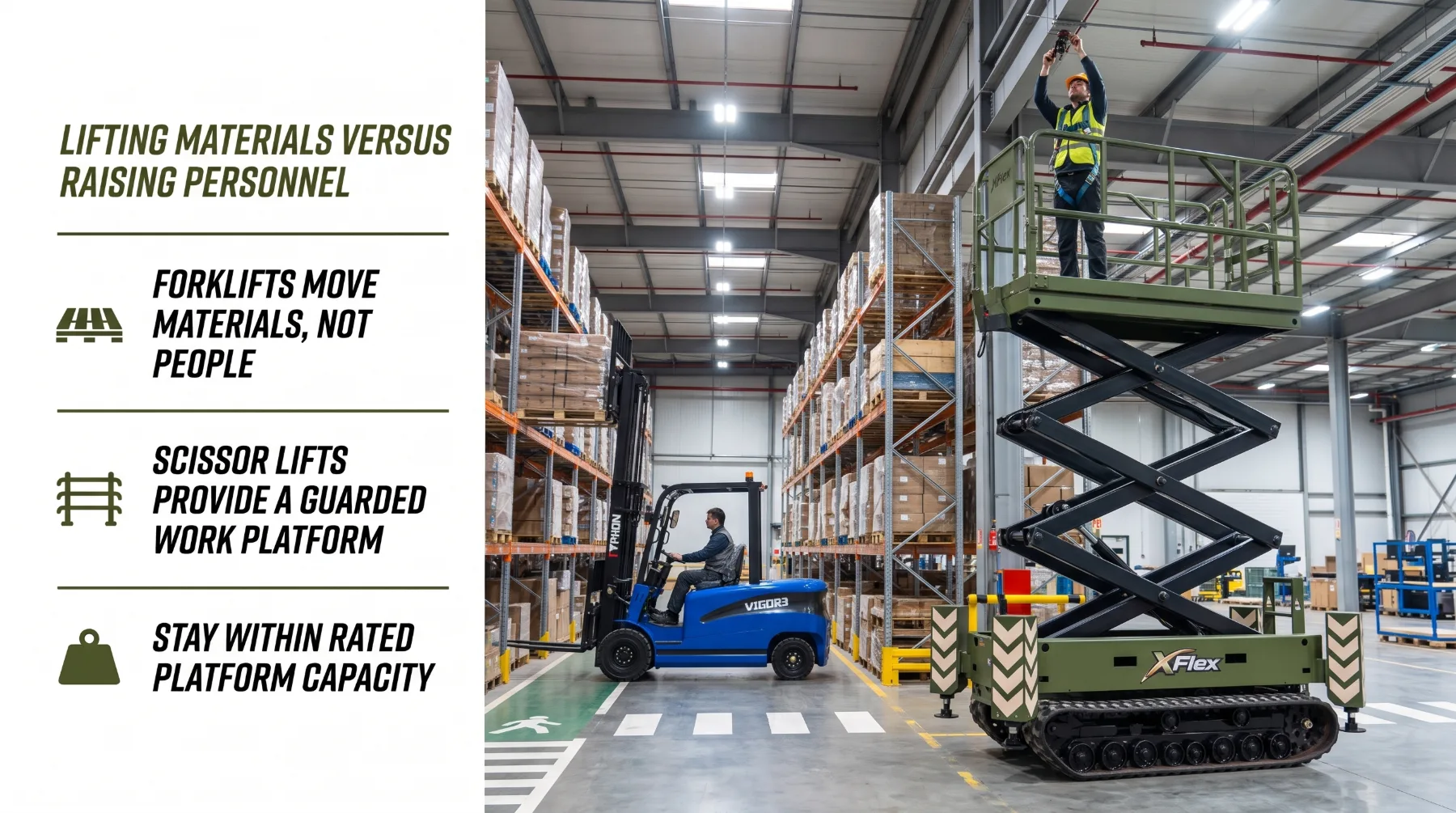
Forklifts are intended for material handling. Standing on the forks, riding on a pallet, or using a bucket or container as an improvised work platform exposes workers to serious fall and crush hazards. Forks offer no guardrails, no secure footing, and no controls for the person being lifted. A sudden mast movement, a bump from the operator, or a shift in balance can throw a worker from height in an instant.
Some forklifts may be used with an approved personnel platform. That arrangement is permitted only when the truck and the platform are specifically designed and authorized for that purpose under the manufacturer’s guidance and the applicable workplace requirements. Approved platforms include guardrails, secure attachment to the forks or carriage, and defined procedures for the operator and the elevated worker. Even then, many facilities find a purpose-built aerial platform the safer and more productive choice for routine elevated work.
A scissor lift is built for personnel from the ground up. Its platform has guardrails, a gated or chained entry, slip-resistant decking, and controls that the worker on the platform uses directly. Emergency stop and emergency lowering functions are standard features. That design allows workers to position themselves accurately and remain protected throughout the task.
Platform safety still depends on correct use. Personnel must stay within the platform’s rated capacity, which includes the combined weight of workers, tools, and materials. Workers should never stand on guardrails, climb out of the platform, or use ladders or boxes to gain extra height. Follow the manufacturer’s instructions and your site’s fall protection requirements, and inspect guardrails, gates, and controls before every use.
Key takeaway: Never use forklift forks or ordinary pallets as an improvised personnel platform; use a scissor lift or an approved personnel-lifting system, and keep every platform within its rated capacity for workers, tools, and materials.
Conclusion
Electric forklifts and scissor lifts both support indoor construction and industrial maintenance, but each delivers its full value only when it is assigned to the work it was designed to perform: electric forklifts lift, carry, and place materials, while scissor lifts raise personnel and their tools on a guarded platform; forks and ordinary pallets must never serve as improvised work platforms, and every scissor lift platform must stay within its rated capacity for workers, tools, and materials; both machines need suitable floors, confirmed load limits, and adequate clearance through doorways, aisles, and overhead spaces; forklift capacity depends on load center, lift height, mast, and attachments, while scissor lifts are rated by platform height, working height, and platform capacity; battery runtime depends on workload, temperature, condition, and disciplined charging in safe, well-ventilated areas; and sound equipment selection weighs the task, height, floor conditions, operator qualifications, and site safety procedures together. Before your next indoor project, list every task and identify whether it involves moving materials or positioning workers, measure required heights and material weights, walk the travel routes to check floors, doorways, and overhead obstructions, confirm operator training for each machine, schedule charging around the work plan, and review fall protection and emergency procedures so every lift on your site is matched to the right machine.
Frequently Asked Questions
Can an electric forklift be used to lift workers?
Only when the forklift and an approved personnel-lifting platform are specifically designed and authorized for that purpose under the manufacturer’s guidance and applicable workplace requirements. Ordinary forks, pallets, and containers must never be used as improvised work platforms. For routine elevated work, a purpose-built aerial platform such as a scissor lift is usually the safer choice.
Is a scissor lift suitable for moving pallets?
No. A scissor lift is not a replacement for a forklift. Its platform is designed for personnel and permitted tools or materials within its rated capacity, not for general pallet handling. When heavy or bulky materials need to reach a work area, use a forklift to stage them and the scissor lift for the installation work.
Are electric forklifts suitable for indoor warehouses?
Yes. Electric forklifts are widely used indoors because they produce no exhaust emissions at the point of use and operate quietly. The facility still needs suitable floors, safe traffic routes, and properly ventilated charging areas. Operators must also be trained and authorized for the specific truck.
What should be checked before using a scissor lift indoors?
Check floor capacity and surface condition, overhead clearance, and the rated platform capacity for workers, tools, and materials. Inspect guardrails, entry gates, controls, emergency stop, and emergency lowering functions before use. Confirm that each operator has completed the required training and that a rescue plan is in place.