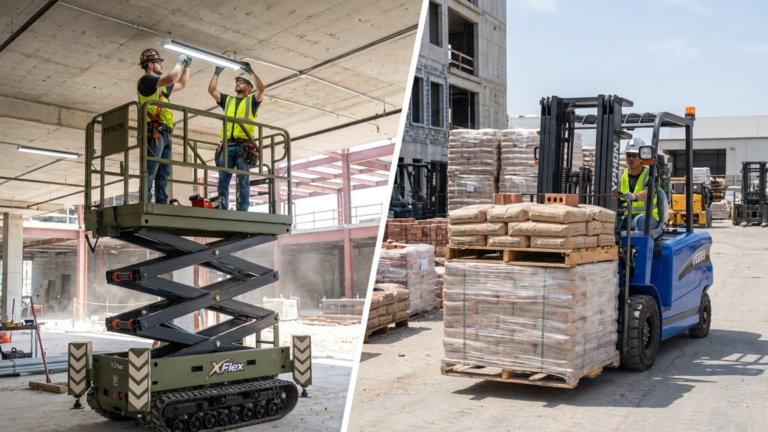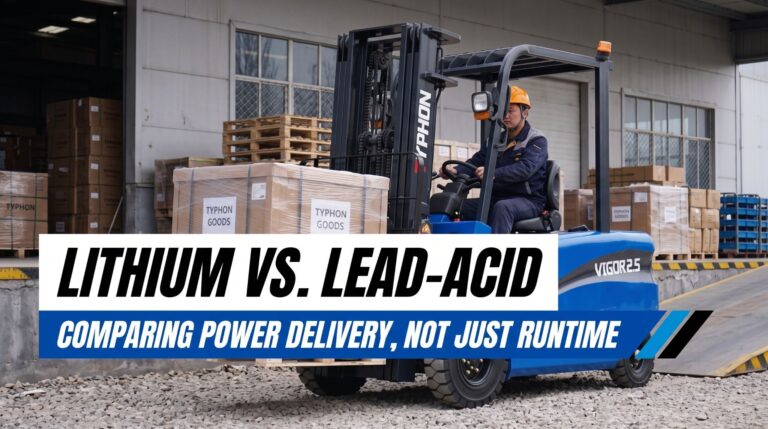
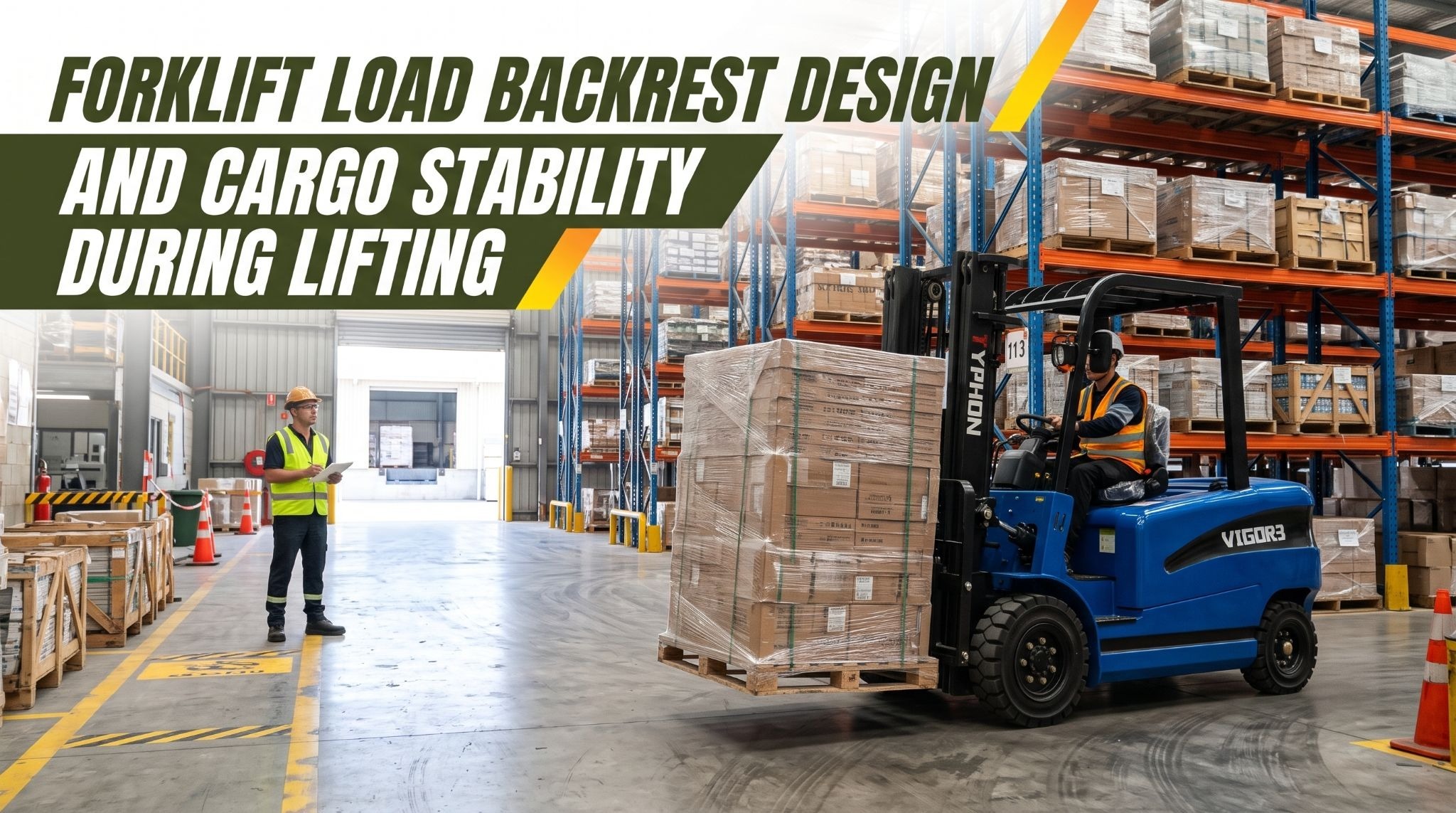
A building supply yard is restocking its warehouse racks before the spring rush. A counterbalance forklift operator picks up a pallet of boxed ceramic tile stacked well above the standard load backrest. The load is wrapped, the pallet is in good condition, and the weight on the label sits comfortably within the truck’s rated capacity. He lifts the pallet toward the top beam and tilts the mast back slightly to settle it, which is his normal habit. The bottom layers rest firmly against the backrest. The top two layers sit above it, with nothing behind them.
As the mast reaches full height, the forklift rolls over a small expansion joint in the floor. The load sways. The top cartons slide rearward, break through the stretch wrap, and tumble over the backrest. One box strikes the overhead guard and splits open, and tile shards rain down beside the cab. The operator isn’t hurt, but the area is closed for an hour while the crew cleans up broken products and inspects the truck.
The forklift wasn’t defective, and the pallet wasn’t overweight. The backrest was simply too short for the height of that load. Nobody had checked whether that cargo needed a taller extension before it was lifted.
A load backrest is one of the simplest components on a forklift, and one of the easiest to overlook. It supports loads against the carriage and helps keep cargo from shifting rearward toward the mast and operator. Its height, design, condition, and fit with the load all affect how well it does that job. It also has clear limits. It doesn’t raise capacity, it doesn’t secure loose goods, and it can’t make up for poor stacking or careless driving. This guide explains how load backrests work, how to choose and inspect them, and how to handle loads so cargo stays stable from pickup to placement.
Understand the Purpose of a Load Backrest
The load backrest, often called a load backrest extension, is the vertical frame mounted on the fork carriage behind the forks. It rises above the carriage and gives the rear of the load a surface to rest against during lifting, tilting, and travel. When the mast tilts back, the load leans into the backrest instead of sliding toward the mast. When the truck brakes or rolls over uneven floors, the backrest helps keep the upper part of the load from moving rearward.
The backrest matters most when the load extends above the carriage. A single solid item, such as a crated machine or a pallet of bagged cement, may sit low and need little rearward support. Tall stacks of cartons, layered building products, boxed tile, bundled conduit, and mixed palletized goods behave differently. Their upper layers can shift, sway, or topple. Without a backrest of suitable height, those items can fall toward the mast, through the mast channels, or onto the overhead guard and the operator compartment.
Understanding these limits shapes how operators use the backrest. It supports a load. It doesn’t hold the load together, prevent forward or sideways shifting, or add capacity. A well-designed backrest on a well-built, well-secured load gives operators real protection. A backrest on a loose, overstacked, or overweight load gives a false sense of security.
Key takeaway: The load backrest helps prevent cargo from moving rearward toward the mast and operator, and OSHA requires one whenever it’s needed to minimize that risk. It supports the load, but it doesn’t secure cargo or increase capacity.
Check Backrest Height and Design
A load backrest only protects the parts of a load it can reach. Its height, opening size, and construction should match the cargo your operation handles most. Choosing the right design starts with an honest look at your loads, not with the backrest that happened to come on the truck.
Height is the first consideration. Many forklifts ship with a standard backrest suited to typical palletized loads. When your crews regularly handle cargo stacked higher than that backrest, such as tall carton loads, boxed fixtures, or layered materials, the upper portion has no rearward support. Taller backrest extensions are available for many models. The goal is for the backrest to support the load’s center of gravity and its upper layers, so a sway or sudden stop doesn’t send items over the top.
Opening size matters as much as height. Backrests are commonly built from vertical or horizontal bars, a grid, or a combination of bars and mesh. The spaces between bars must be small enough to stop the smallest items you lift from slipping through toward the mast. A backrest with wide bar spacing may work well for large cartons and crates. Small boxes, bags, bottles, cans, and loose fittings can pass through those openings. Operations that handle small items often fit a mesh screen or a backrest with closer spacing, as approved by the manufacturer.
Visibility affects design choices too. A taller or more solid backrest can block part of the operator’s view through the mast. Many backrest designs balance protection with sight lines by using bars or open mesh rather than solid plate. When comparing options, have operators sit in the seat and judge their view of the fork tips, rack beams, and travel path with the backrest fitted.
Compatibility with the carriage and attachments comes next. Backrests are designed for specific carriage classes and widths, and they often attach with bolts or are welded to the carriage. Sideshifters, fork positioners, and other attachments may include an integrated backrest or require a specific design. Confirm that any backrest fits the carriage class, width, and attachment configuration on your exact truck.
Key takeaway: Match backrest height, opening size, and construction to the tallest and smallest items you lift, and confirm fit with the carriage and attachments. Use only manufacturer-approved backrests, and never modify the structure without written approval.
Inspect the Backrest and Fork Carriage
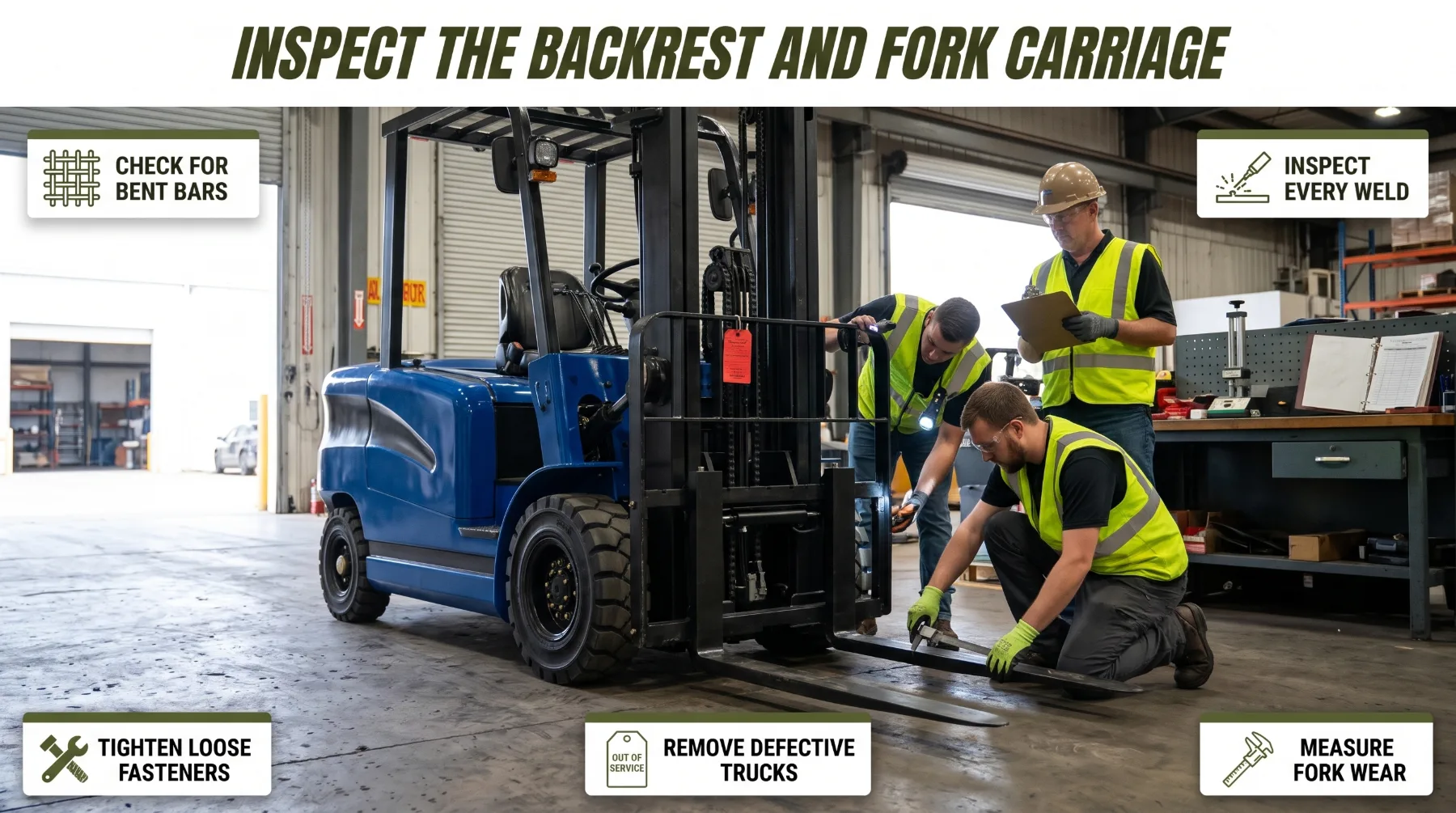
A load backrest takes repeated knocks from pallets, rack beams, doorways, and cargo. Over time, bars bend, welds crack, and fasteners loosen. A damaged backrest may not support a load when it matters most, and the damage often signals impacts that have affected the carriage and forks as well. A thorough inspection catches these problems before they cause an incident.
Inspect the backrest itself. Look for bent, cracked, or missing bars, and check that the spacing between them hasn’t widened from impacts. Examine every weld for cracks, especially where bars meet the frame and where the backrest joins the carriage. Check mounting bolts for looseness, missing fasteners, and elongated holes. Look for fresh paint scrapes, dents, and distortion that point to recent impacts, and ask operators what happened. A backrest that leans forward or backward from its original position may have been struck hard enough to damage the carriage beneath it.
Inspect the fork carriage. Check the carriage plate and bars for cracks, bends, and wear. Look at the carriage rollers and their contact with the mast channels, along with the fork retaining pins or latches that keep the forks from sliding off the carriage. Confirm that fork positioning locks engage fully.
Inspect the forks closely. Look for cracks at the heel, the area where the blade meets the shank, which carries the highest stress. Check for bent or twisted tines, uneven fork tip height, and worn hooks. Many fork manufacturers and industry standards, including ISO 5057, call for a fork to be removed from service when wear reduces blade or shank thickness by 10 percent from its original dimension. Use calipers or a fork wear gauge to check thickness during periodic inspections. Forks should be inspected by a qualified person at least annually, and more often in heavy-use operations.
Check mounting points and related components. Inspect the chains, chain anchors, and mast for damage, and look at the overhead guard for cracks or bends. Any impact strong enough to bend a backrest may have stressed these parts too.
Key takeaway: Inspect the backrest, carriage, forks, and mounting points before every shift. Remove any truck with cracked welds, bent bars, loose fasteners, or damaged forks from service until a qualified technician completes approved repairs.
Position Loads Against the Backrest
The backrest works best when the load is placed correctly on the forks. A load that sits partway out on the forks, leans off-center, or leaves a large gap behind it gains little support from the backrest. It also places the load’s weight farther forward than necessary, which reduces stability. Good positioning starts before the forks ever leave the ground.
Check the load’s stability and counterweight design before lifting. Look for damaged pallets, broken deck boards, crushed corners, and loose wrap. Watch for cartons that overhang the pallet edges, items stacked unevenly, and heavy goods placed on top of lighter ones. Loose or poorly stacked goods may need restacking, banding, stretch wrapping, or corner boards before they move. Bagged materials such as cement and mortar can slump and shift. Drums, rolls, and cylinders can roll if they aren’t chocked or strapped. Long items such as lumber bundles, pipe, and conduit may need special attachments or securing.
Some loads don’t sit flat against the backrest. Crates with skids, irregular machinery, and cargo with protruding parts may contact the backrest only at a few points or not at all. Position these loads according to their shape and the manufacturer’s handling guidance, and secure them as needed. Never wedge objects between the load and the backrest to fill a gap.
Lift the load slightly, just clear of the floor or rack, and pause. Tilt the mast back gently and watch for movement. If the load shifts, leans, or sags, lower it and correct the problem before going further. That brief check catches most stability issues while the load is still close to the ground.
Key takeaway: Insert the forks fully, center the load, and place it against or close to the backrest where its design permits. Secure loose or poorly stacked goods before lifting, and test stability with a short lift before traveling or raising the load.
Consider Load Center and Capacity
A load backrest affects where cargo sits on the forks, which makes it closely linked to the truck’s rated capacity. Capacity depends on how much a load weighs and how far its center of gravity sits from the fork face. Understanding that relationship helps operators recognize when a load that looks manageable is actually beyond the truck’s limit.
Lift height and mast configuration also matter. Many trucks have reduced capacity at higher lift heights, and the data plate often lists capacity at more than one height. A load that’s within capacity at 10 feet may exceed it at the top of a tall mast.
Consider the effect of attachments on capacity. Attachments such as sideshifters, fork positioners, clamps, rotators, and extended forks add weight to the forklift and can shift the load center forward. These changes reduce the available lifting capacity and may affect stability. Use only approved attachments that are compatible with the truck, and ensure the capacity information reflects the installed equipment. Backrest extensions and other modifications should also be approved because they can affect the truck’s rated capacity and safe operation.
Verify load weight and capacity before lifting. Check the forklift’s data plate and capacity information before handling unfamiliar loads. Confirm the load weight using labels, shipping documents, or a suitable weighing method. Consider the load center, lifting height, and weight distribution, since uneven or top-heavy materials can shift the center of gravity away from the middle of the pallet. Never lift a load if its weight exceeds the forklift’s rated capacity or if its compatibility with the truck’s lifting limits cannot be confirmed.
Remember that the backrest never adds capacity. It supports the load against rearward movement. It doesn’t change the truck’s stability, counterweight, or rated limits.
Key takeaway: Capacity depends on load weight, load center, lift height, and attachments. Keep loads pushed back to minimize load center, check the data plate before lifting, and remember that a backrest never increases rated capacity.
Follow Safe Lifting and Travel Practices
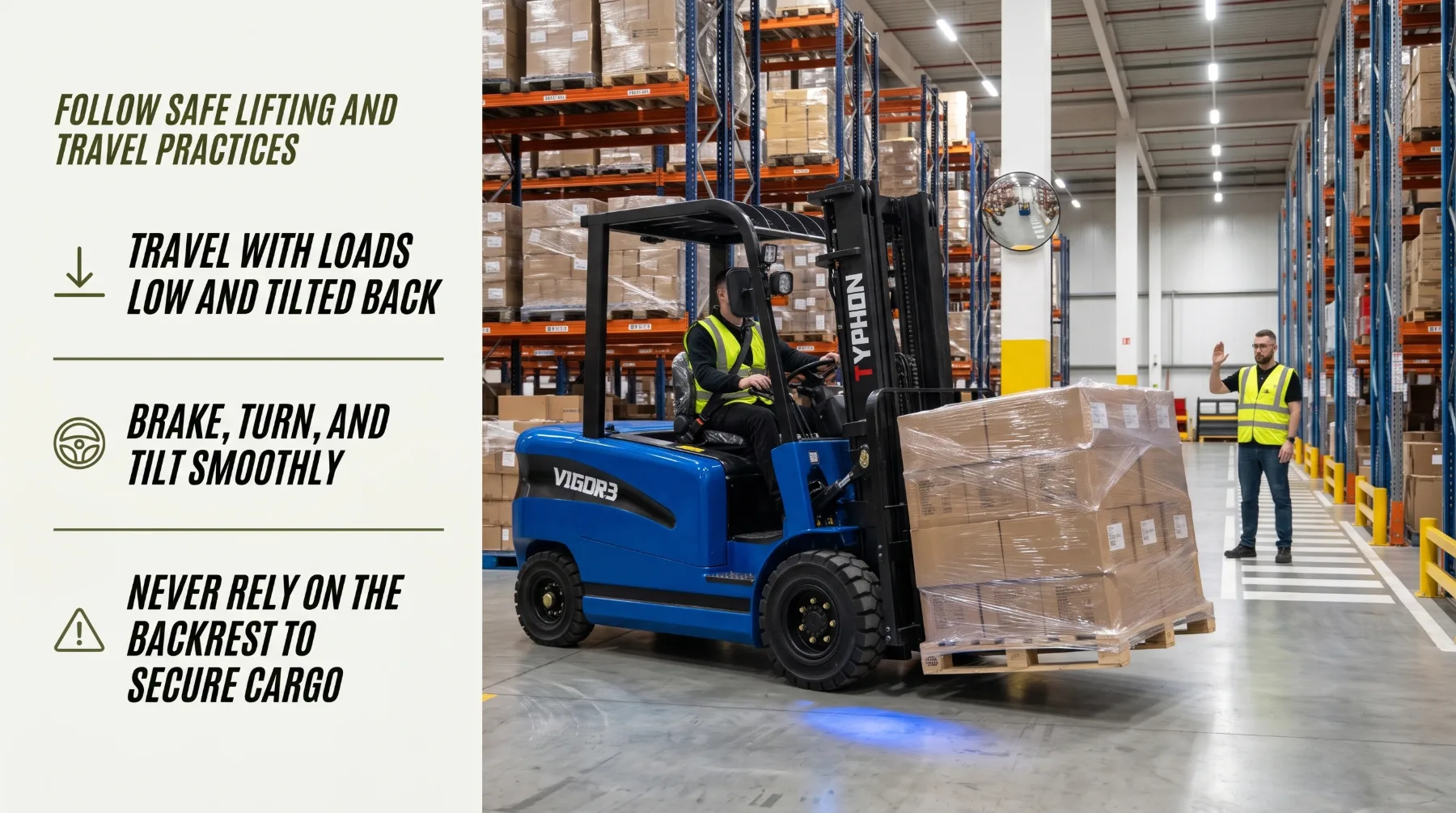
Even the best backrest can’t protect a load from poor handling. Sudden braking, sharp turns, fast tilting, and travel with raised loads create forces that can shift cargo forward, sideways, or over the top of the backrest. Smooth, deliberate operation keeps loads stable and protects operators and pedestrians.
Keep loads low while traveling. Carry the load just high enough to clear the floor and any obstacles, usually a few inches, with the mast tilted back so the load rests against the backrest. A low load keeps the combined center of gravity down and gives the truck its widest stability margin. Raise the load only when the truck is positioned and stopped at the rack or stack.
Avoid sudden braking, turning, and tilting. Operate the forklift at a controlled speed that allows safe stopping and maneuvering. Accelerate gradually, brake smoothly, and slow down before turns. Sudden movements can shift loads, loosen stacked materials, and damage protective wrapping. Tilt the mast gradually, particularly when handling tall or unbalanced loads. Avoid forward tilting while carrying an elevated load, except when positioning it for placement or stacking.
Maintain clear visibility at all times. Tall or bulky loads can obstruct the operator’s forward view. When visibility is limited, travel in a direction that provides a clear view of the travel path. Slow down and sound the horn at intersections, blind corners, and other obstructed areas. Use a spotter when necessary, and keep mirrors, windows, and lights clean.
Choose suitable travel routes. Plan travel paths with smooth, level surfaces, adequate overhead clearance, and enough space to maneuver safely. Watch for expansion joints, dock plates, drains, potholes, and uneven flooring, as sudden impacts can destabilize loads. When traveling on ramps, follow safe operating practices by keeping the load facing uphill and the mast tilted back. Keep the forks low enough to maintain ground clearance without unnecessarily raising the load.
Protect people around the forklift. Never allow anyone to stand or pass beneath an elevated load or forklift lifting mechanism. Keep pedestrians away from operating areas using marked walkways, warning signs, and physical barriers. Operators should use available safety restraints, including seat belts, to remain protected within the operator compartment if the forklift tips over.
Never use the backrest as a substitute for correct load securing or safe stacking. Don’t lean loads against it to hold them together, stack goods above it to squeeze in more cargo, or push loads with it. Make sure every operator is trained and evaluated as OSHA’s 29 CFR 1910.178(l) requires, including the specific truck, its attachments, and the loads your operation handles.
Key takeaway: Travel with loads low and tilted back, move and tilt smoothly, keep a clear view of the path, and plan level routes. Never rely on the backrest to hold together loose or overstacked cargo.
Conclusion
A properly designed and maintained forklift load backrest helps prevent cargo from falling rearward toward the mast and operator compartment. Any structural modification must have manufacturer approval. Operators should position loads fully, center them, and secure unstable items while respecting the truck’s rated capacity, which can change with load center, lift height, and attachments. A load backrest does not increase lifting capacity. Regular inspections of the backrest, carriage, and forks, combined with smooth lifting and travel, help keep cargo stable. Review the loads your operation handles and compare their dimensions and weights with your fleet’s backrests. Request approved extensions from the manufacturer or dealer when needed, include backrest and fork checks in pre-shift inspections, and reinforce operator training on load positioning, capacity, and safe travel. These practices help protect operators, cargo, and equipment.
Frequently Asked Questions
What does a forklift load backrest do?
It supports certain loads against the carriage and helps prevent cargo from moving rearward toward the mast and operator. It’s especially important for loads stacked above the carriage, such as tall carton stacks and layered building materials. OSHA’s 29 CFR 1910.178(m)(7) requires one whenever necessary to minimize the risk of a load falling rearward.
Does a load backrest increase forklift capacity?
No. Capacity must be determined from the forklift’s data plate and approved configuration, considering load weight, load center, lift height, and attachments. A backrest supports the load against rearward movement, but it doesn’t change the truck’s stability or rated limits. A heavier backrest extension may even affect capacity, so use only manufacturer-approved designs.
Should every load touch the backrest?
Loads should be positioned securely according to their shape and the manufacturer’s handling guidance. Most palletized loads should be pushed fully back against or very close to the backrest to minimize load center. Crates, machinery, and irregular cargo may contact it only partly, and they should be secured as needed rather than wedged into place.
Can a damaged backrest remain in service?
No. Bent bars, cracked welds, loose fasteners, and widened openings reduce the backrest’s ability to support a load. The truck should be removed from service, as OSHA’s 29 CFR 1910.178(q)(1) requires, and repaired by a qualified technician using approved parts before further use.