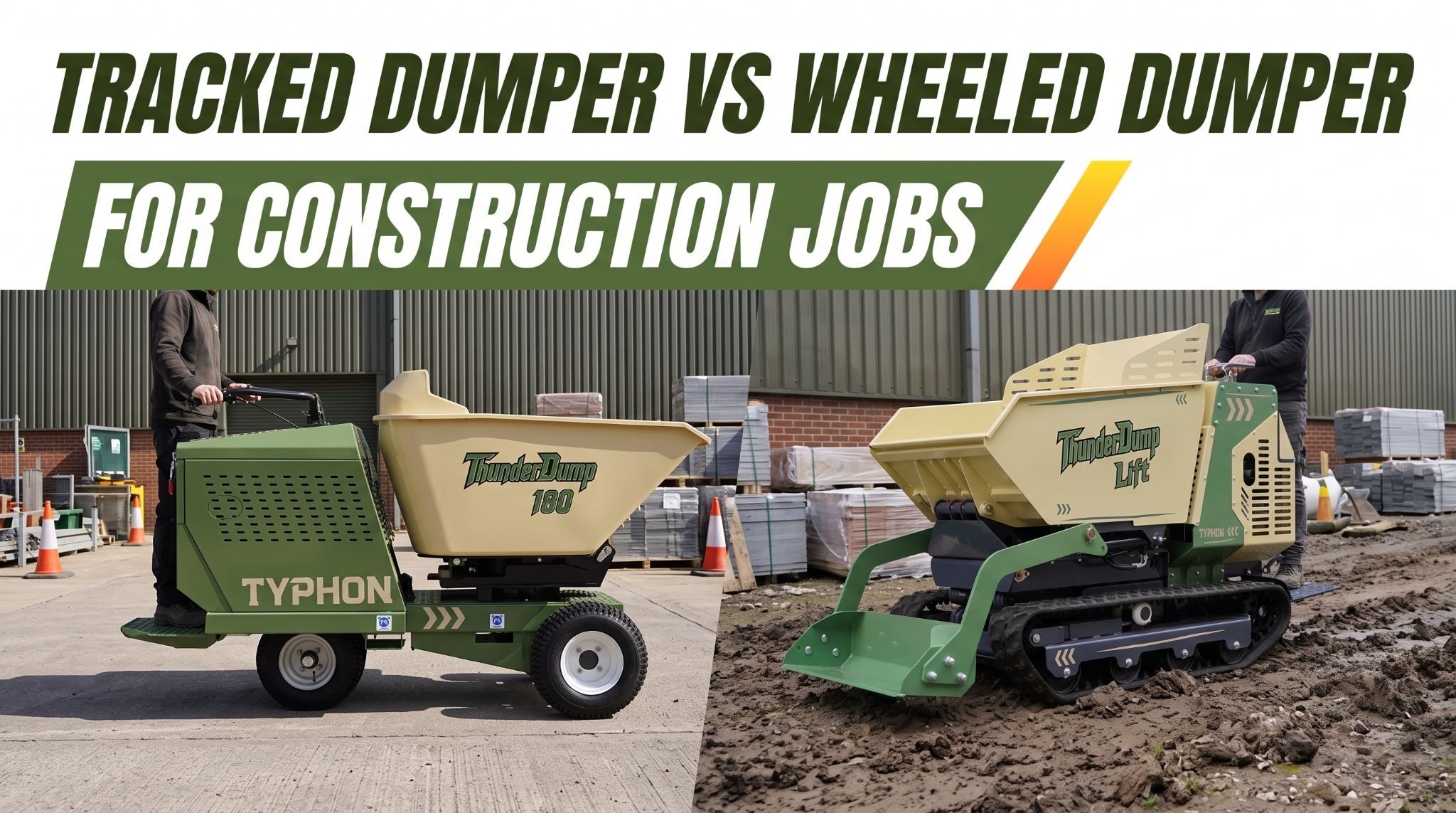
Across a single jobsite, ground conditions can change significantly from one work area to another. Near the entrance, a compacted haul road may lead to a firm staging area where material moves easily. Toward the back, the ground can turn soft and uneven, churned up by earlier work and holding water after recent rain. Soil, gravel, and debris still have to move across both zones throughout the day, so the machine chosen to haul them needs to cope with changing terrain.
That split is exactly why the choice between a tracked dumper and a wheeled dumper matters. The two designs meet the ground in different ways, and that difference shapes how each machine handles traction, ground pressure, maneuverability, and travel across the worksite. Surface conditions can therefore affect which design is more suitable for a particular hauling route.
During daily material transport, matching the dumper’s hopper design to the material can make loading and unloading more predictable. Hopper shape, capacity, sidewall height, and discharge design all affect how efficiently materials are carried and released. Looking at the material type, load volume, and dumping requirements helps determine which hopper configuration fits the work cycle.
Ground Conditions Set the Starting Point
The surface beneath the machine is where any comparison should begin, because it directly influences traction, stability, and travel efficiency. A dumper that grips and moves confidently on one surface may struggle on another, so the ground sets the terms for everything that follows.
The core difference comes down to how each design contacts the surface. Tracks provide continuous ground contact along their full length, while wheels rely on individual tire contact points. That distinction affects how each machine spreads its weight and holds traction, and it explains why the two designs suit different conditions. Rather than judging by a single surface, contractors should evaluate all the surfaces the machine will cross during a normal work cycle, since most sites present more than one.
Key takeaway: Tracks give continuous ground contact while wheels rely on individual tire points, so evaluate every surface the machine crosses in a normal work cycle rather than judging by one alone.
Tracked Models Handle Soft Ground
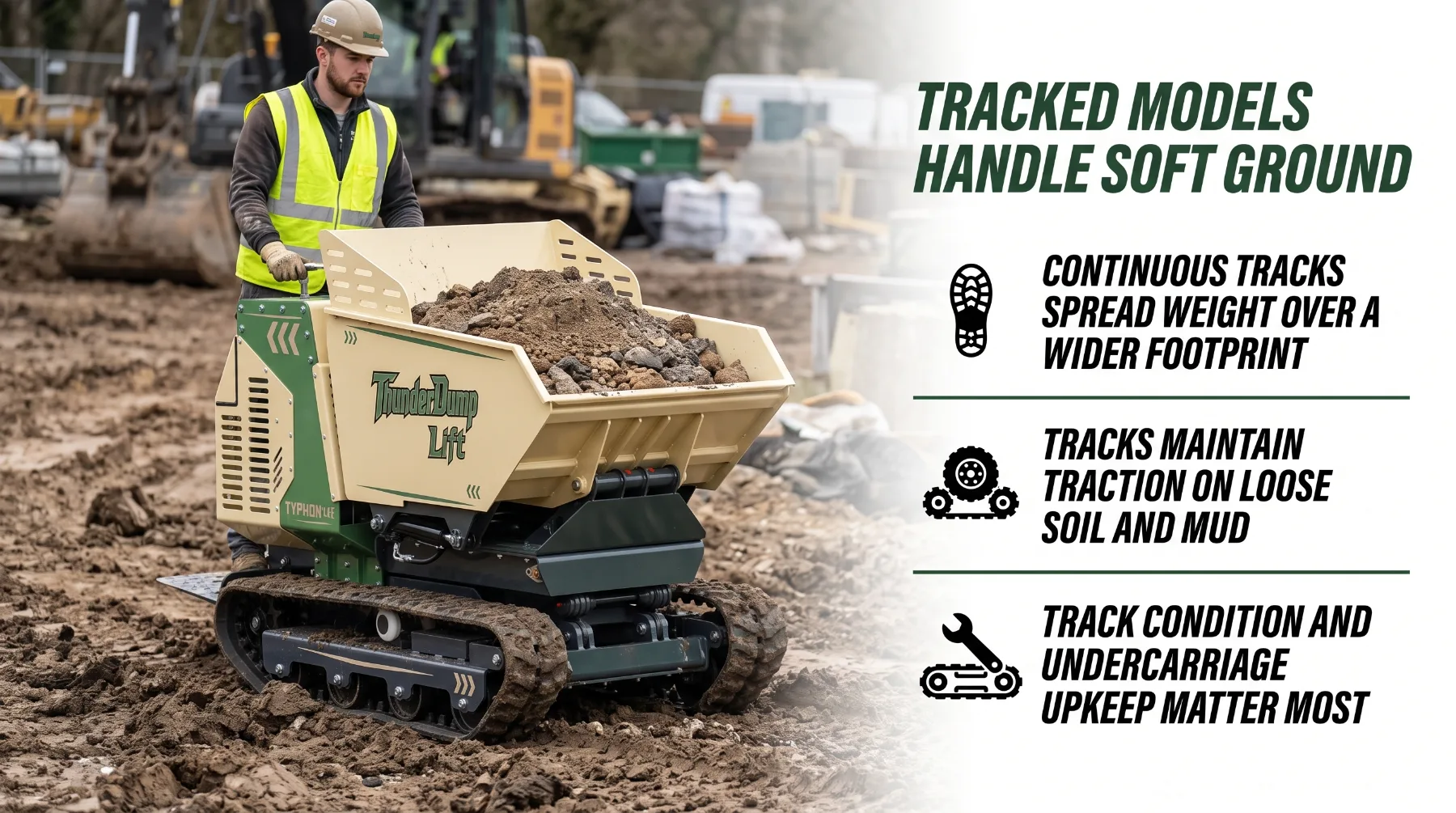
When the surface turns soft, a tracked dumper comes into its own. Its continuous tracks distribute the machine’s weight over a broader contact area rather than concentrating it through individual tires. That wider footprint is the source of its advantage on difficult ground.
This matters most where wheels tend to struggle. On loose soil, mud, or uneven terrain, spreading the weight helps the machine keep traction and stay on top of the surface instead of digging in. For sites where maintaining grip is a constant challenge, that traction keeps material moving when a wheeled machine might lose ground. The trade-off is upkeep: track condition and undercarriage maintenance remain important, since worn or poorly maintained tracks undercut the very contact the design depends on.
Key takeaway: Tracked dumpers spread weight over a broad contact area for traction on loose soil, mud, and uneven ground, but track condition and undercarriage maintenance are essential to keep that performance.
Wheeled Models Suit Firm Routes
On solid ground, a wheeled dumper delivers efficient travel. Wheeled machines move well across firm and prepared surfaces, where tires roll with little resistance and keep cycle times short. That efficiency is a real advantage when the ground supports it.
Tires are well suited to established construction routes, compacted ground, and other areas where rolling travel is practical. Over repeated trips along a firm haul road, that easy rolling adds up across a shift and keeps the machine productive. Travel distance and site layout weigh heavily here: the longer the route and the firmer the surface, the more a wheeled configuration tends to pay off. Where hauling covers real distance across prepared ground, a wheeled dumper is hard to beat.
Key takeaway: Wheeled dumpers travel efficiently across firm, prepared surfaces and established routes, with longer distances and solid ground favoring a wheeled configuration.
Maneuverability Depends on the Work Area
How well a dumper moves through a site depends on more than the surface underneath it. Construction sites rarely share the same layout, and a project may combine narrow access points, open material routes, slopes, and scattered obstacles. The machine has to navigate all of it while keeping material moving.
This is where machine dimensions and steering characteristics deserve attention alongside the ground-contact system. A machine that travels well across open ground can feel awkward in a tight corner or a narrow gate, so turning space and route width matter as much as traction. Confirm the dumper can position itself where it needs to, pass through the tighter points, and handle any slopes on the route. Matching size and steering to the work area keeps the machine practical rather than fighting the layout at every turn.
Key takeaway: Sites combine narrow access, slopes, and obstacles, so weigh machine dimensions and steering characteristics alongside the ground-contact system when choosing a dumper.
Payload Affects Productivity
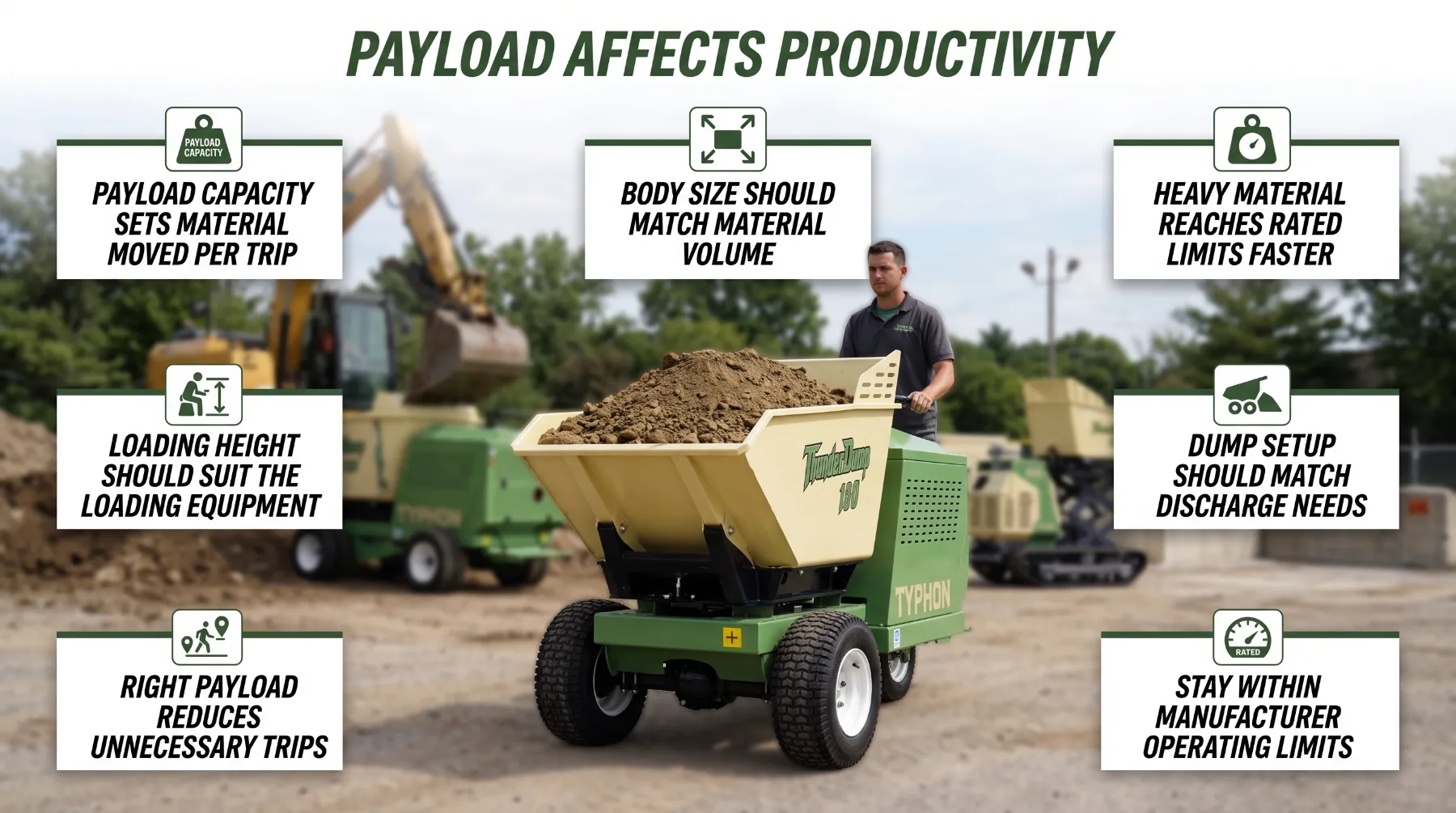
Efficient hauling depends on how much material the dumper can carry on each trip. Both tracked and wheeled dumpers need to handle the required load without creating unnecessary trips, making payload an important factor when matching the machine to the job.
Productivity also depends on body size, loading height, and dumping arrangement. These factors determine how easily the machine can be loaded, transported, and unloaded while staying within its rated operating limits.
- Payload Capacity: Determines how much material can be carried on each trip.
- Body Size: Should match the volume and type of material being hauled.
- Material Weight: Heavy materials can reach the rated payload limit faster than lighter materials.
- Loading Height: Should suit the equipment used to load the dumper.
- Dumping Arrangement: The dump setup should match where and how the material needs to be discharged.
- Trip Frequency: A suitable payload can reduce unnecessary trips and keep the hauling cycle moving.
- Rated Limits: Loads must remain within the manufacturer’s specified operating capacity for safe and reliable performance.
Key takeaway: Payload capacity, body size, loading height, and dumping arrangement drive the number of trips per day, and the machine must stay within its rated operating limits.
Maintenance Needs Differ
The two designs ask for different upkeep, and that’s worth weighing before you commit. The main difference lies in the ground-contact system. Wheeled machines need regular inspection of tires and wheel-related components, checking for wear, damage, and correct condition. Tracked machines instead need attention to the tracks, rollers, sprockets, and the rest of the undercarriage.
Beyond that, both types share a common core of maintenance. Routine engine, hydraulic, lubrication, and structural upkeep applies regardless of whether the machine runs on wheels or tracks. Keeping fluids sound, the hydraulics working, the structure inspected, and the lubrication points serviced supports reliable performance on either design. Factoring the design-specific ground-contact maintenance alongside these shared tasks gives you a realistic picture of what each machine will require over its working life.
Key takeaway: Wheeled machines need tire and wheel maintenance while tracked machines need track, roller, sprocket, and undercarriage attention, but both require routine engine, hydraulic, lubrication, and structural service.
Conclusion
Tracked and wheeled dumpers interact differently with the ground, so their suitability depends on terrain, travel distance, payload, access, and the complete hauling cycle. Tracks provide continuous ground contact and distribute machine weight across a broader footprint, which can support traction and stability on soft, loose, muddy, or uneven surfaces, while wheels can travel efficiently across firm, prepared routes and longer distances. Machine dimensions, steering, turning space, body capacity, loading height, dumping arrangement, and maintenance requirements also affect practical performance. Payload should remain within the rated capacity, while the body configuration should suit the material and surrounding loading and discharge equipment. Evaluating ground conditions, route length, maneuvering space, material characteristics, payload requirements, and ground-contact maintenance together helps match a dumper configuration to the demands of the jobsite.
Frequently Asked Questions
Are tracked dumpers useful on muddy construction sites?
Yes, tracked dumpers are well suited to muddy construction sites because their continuous tracks spread the machine’s weight over a larger contact area. This helps reduce sinking on soft ground while providing better traction where wheeled machines may struggle. They can continue hauling through wet, loose, or uneven conditions, making them useful for challenging sites. However, tracks and undercarriage components require regular inspection and maintenance to maintain reliable performance.
Where are wheeled dumpers commonly useful?
Wheeled dumpers are commonly useful on firm, prepared surfaces and established haul routes where tires can roll efficiently. Compacted ground and prepared roads allow faster travel with less rolling resistance, which can help shorten repeated hauling cycles. They are particularly suitable for longer routes across solid ground. Soft or muddy conditions, however, may favor a tracked configuration because of its greater ground contact and traction.
Does payload differ between wheel and track designs?
Payload depends on the specific dumper rather than whether it uses wheels or tracks. Rated payload, body size, and overall machine design determine how much material it can safely carry. When comparing machines, also consider loading height, body capacity, and dumping arrangement because these affect cycle efficiency and productivity. Regardless of configuration, loads should remain within the manufacturer’s rated operating limits.
How should contractors compare the two?
Contractors should compare tracked and wheeled dumpers based on terrain, travel distance, payload, maneuverability, and maintenance needs. Soft, muddy, or uneven ground generally favors tracks, while firm surfaces and longer haul routes can suit wheels. Compare the rated payload, body size, loading height, and dumping system of specific machines against the workload. Also consider site access, slopes, obstacles, and maintenance requirements. Evaluating these factors together helps match the dumper configuration to the project.
One Comment